Why a Negative Times a Negative Is Positive
It sounds strange that (−3) × (−2) is +6. It isn't a rule someone made up: it is the only answer that keeps the patterns of multiplication working.
Follow the pattern
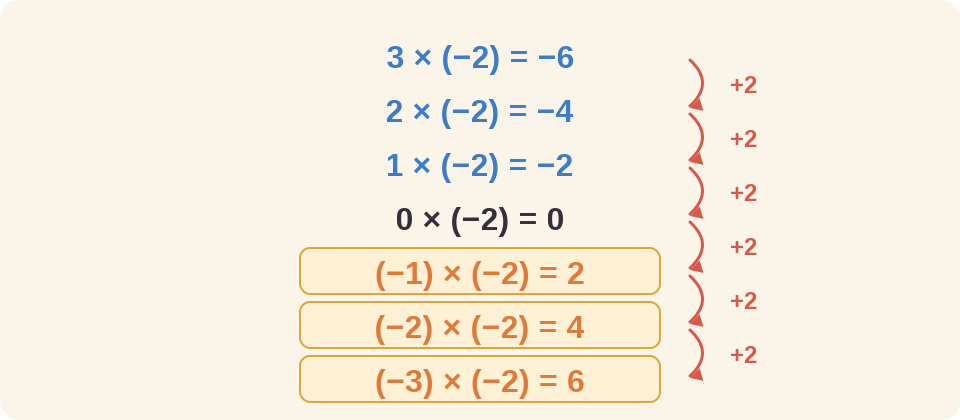
Look at 3 × (−2) = −6, 2 × (−2) = −4, 1 × (−2) = −2, 0 × (−2) = 0. Each time the first factor goes down by 1, the product goes up by 2.
Keep going: (−1) × (−2) = 2, (−2) × (−2) = 4, (−3) × (−2) = 6. The products keep going up by 2, so a negative times a negative is positive.
The distributive property says so too
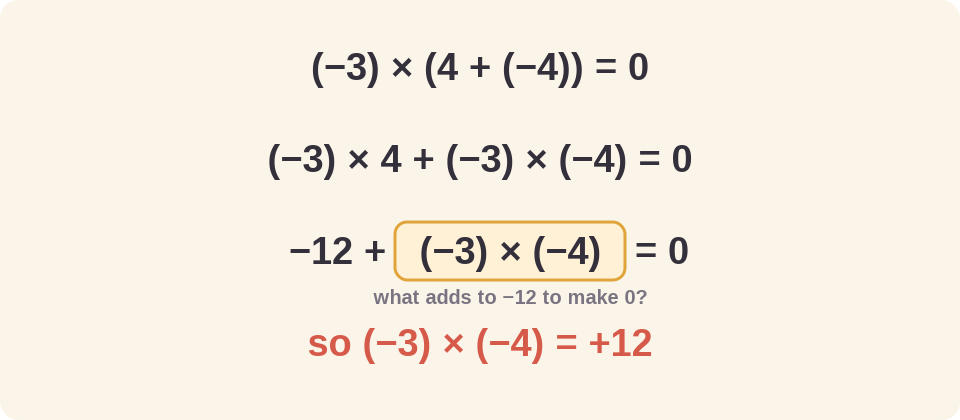
We know 4 + (−4) = 0, so (−3) × (4 + (−4)) = (−3) × 0 = 0.
Multiply each part instead: (−3) × 4 + (−3) × (−4) = 0. The first part is −12, so −12 + (−3) × (−4) = 0.
The only number that adds to −12 to make 0 is 12. So (−3) × (−4) = 12.
Many factors
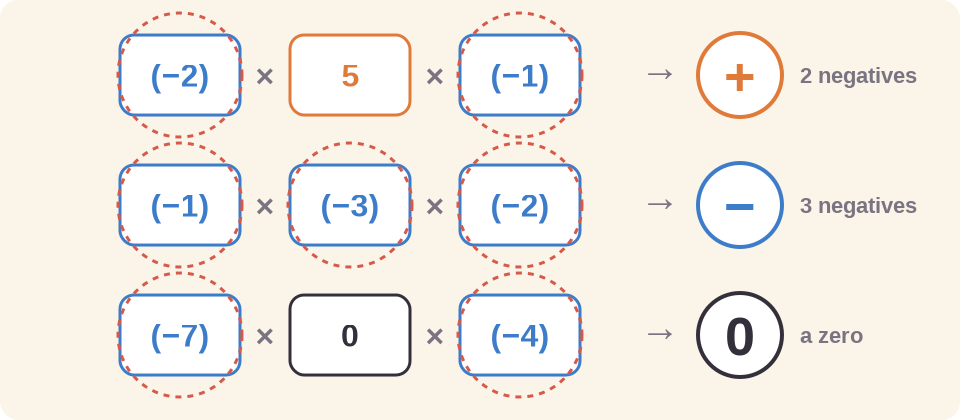
Every pair of negative factors makes a positive. So count the negative factors: an even number of them gives a positive product, an odd number a negative one.
(−2) × 5 × (−1) has two negatives, so it is positive: +10. (−1) × (−3) × (−2) has three, so it is negative: −6. And if any factor is 0, the product is 0.
Careful
Count all the negative factors, not just the first two: (−1) × (−1) × (−1) is −1.
Try it at home
- Write the pattern 3 × (−5), 2 × (−5), 1 × (−5), 0 × (−5) down a page.
- Work out each product and see how much it changes each time.
- Continue the pattern to (−3) × (−5) without using the rule, then check with the rule.
Words in this lesson
- distributive property - a × (b + c) = a × b + a × c.
- sign rule - same signs give a positive product, different signs a negative one.
Big idea
A negative times a negative is positive, because that is the only answer that keeps the pattern and the distributive property true.