Complementary and Supplementary Angles
Some pairs of angles are partners: together they make exactly a right angle, or exactly a straight line. Know one partner and you know the other.
Two kinds of partners
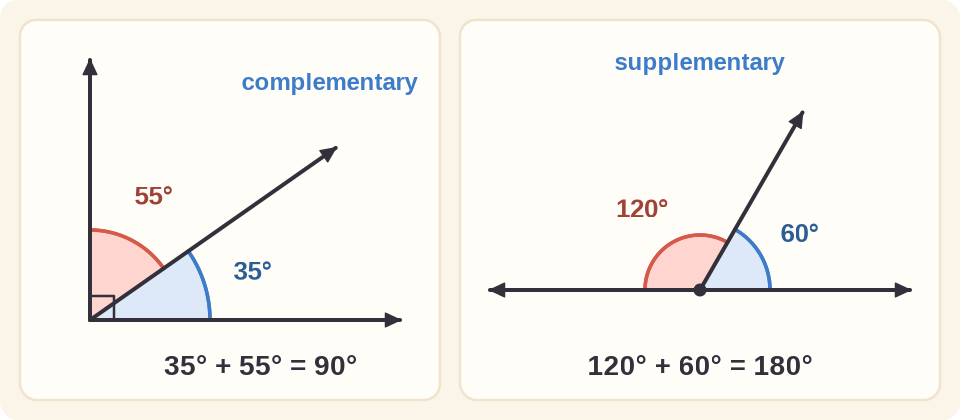
Two angles are complementary when they add up to 90°, a right angle. Two angles are supplementary when they add up to 180°, a straight angle.
Each one is the other's partner. The complement of 35° is 90° − 35° = 55°. The supplement of 120° is 180° − 120° = 60°.
They don't have to touch
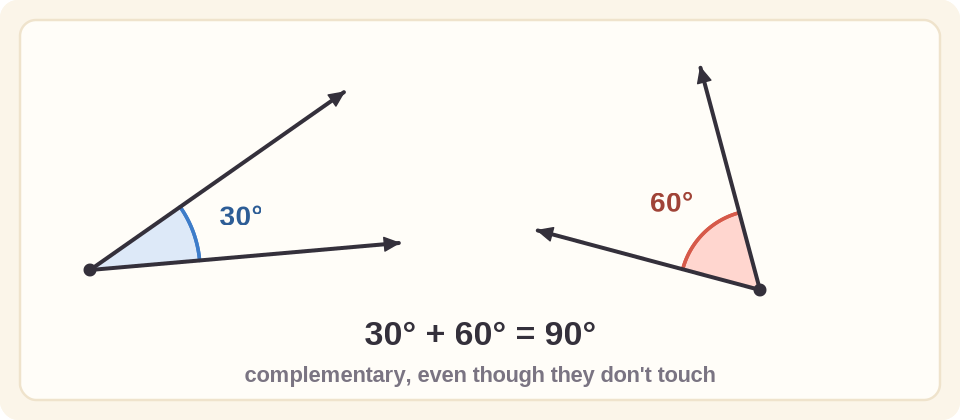
Partners are about sizes, not about where the angles sit. A 30° angle in one corner of a page and a 60° angle in another are complementary, since 30 + 60 = 90.
Only an angle smaller than 90° has a complement. Any angle smaller than 180° has a supplement, so 120° has a supplement but no complement.
To keep the two words apart, think of their first letters: c for corner, the 90° corner of a page, and s for straight, the 180° of a straight line.
Partners in real things
A ladder leans on a wall and makes a 70° angle with the ground. The wall and the ground meet at a right angle, so the angle between the ladder and the wall is the complement: 90° − 70° = 20°.
A road branches off a straight street at 115°. The angle on the other side of the branch is its supplement, 180° − 115° = 65°.
Careful
The supplement of 120° is not 240°: subtract from 180°, never add to it. And 145° is the supplement of 35°, not its complement.
Try it at home
- Fold the corner of a sheet of paper so that the fold cuts the right angle into two angles.
- Measure one of them and work out the other before you measure it.
- Do the same with a straight edge of the sheet and a fold that starts on it.
Words in this lesson
- complementary angles - two angles whose sizes add up to 90°.
- supplementary angles - two angles whose sizes add up to 180°.
- complement, supplement - the angle that makes a given angle up to 90°, or up to 180°.
Big idea
Complementary angles add up to 90° and supplementary angles to 180°, so subtract from 90° or 180° to find the missing partner.