Subtracting Is Adding the Opposite
In the morning it was 6 degrees. At midnight it was −9 degrees. How many degrees did it fall? The answer is a subtraction with a negative number in it: 6 − (−9).
Taking away 3 or adding −3
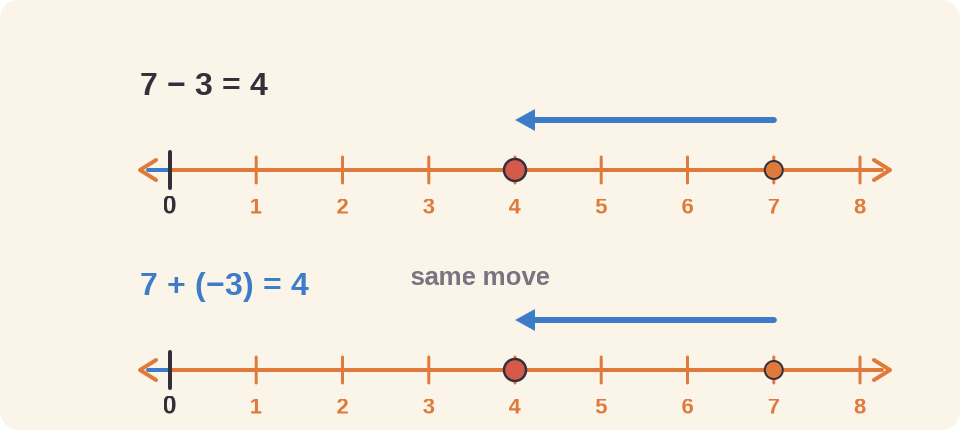
7 − 3 = 4. Now try 7 + (−3): start at 7 and move 3 left. You land on 4 again.
Taking away 3 and adding −3 are the same move. This works for every number: subtracting a number is the same as adding its opposite. In symbols, .
Subtracting a negative
So 5 − (−3) = 5 + (+3) = 8. Subtracting a negative number moves you right.
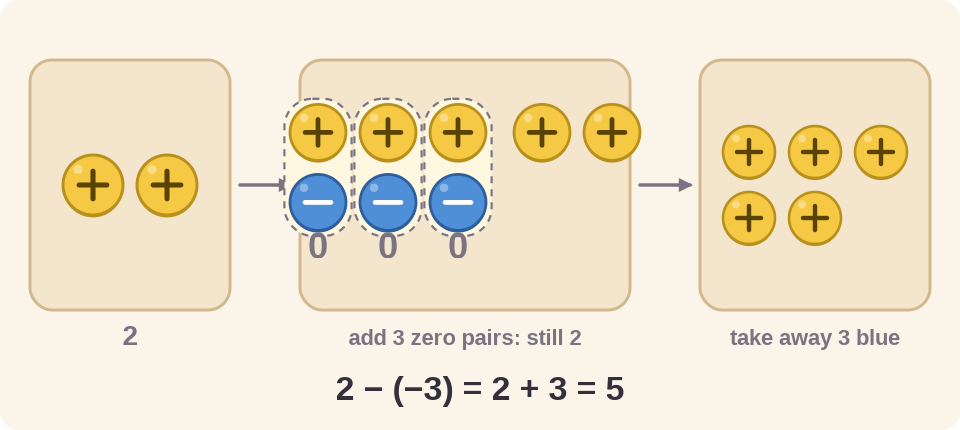
Counters show why. To take 3 blue counters from 2 yellow ones, first add 3 zero pairs; the pile still shows 2. Now take away the 3 blue counters. Five yellow counters are left: 2 − (−3) = 5.
Rewrite, then add
Always rewrite a subtraction as an addition first, then use the rules for adding. −7 − 4 = −7 + (−4) = −11. And 6 − (−9) = 6 + 9 = 15: the temperature fell 15 degrees.
With several numbers, group the ones that are easy together. 23 + (−18) + 17 + (−12) = (23 + 17) + (−18 + −12) = 40 + (−30) = 10.
To check a sum like −389 + 512 roughly, round first: −400 + 500 = 100. The exact answer, 123, is close.
Try it at home
- Look up today's high and low temperatures for a cold city, like Winnipeg or Moscow.
- Write the difference as high − low, rewrite it as an addition, and work it out.
- Check your answer by counting degrees on a drawn thermometer.
Words in this lesson
- difference - the result of a subtraction.
- opposite - the same size with the other sign; subtracting a number adds its opposite.
Big idea
To subtract a number, add its opposite: p − q = p + (−q), so 5 − (−3) = 5 + 3.