Slicing Solids
Slice a cucumber straight across and each slice is a circle. Slice it on a slant and the slices stretch into ovals. The shape on a cut depends on the solid and on the cut.
Families of solids
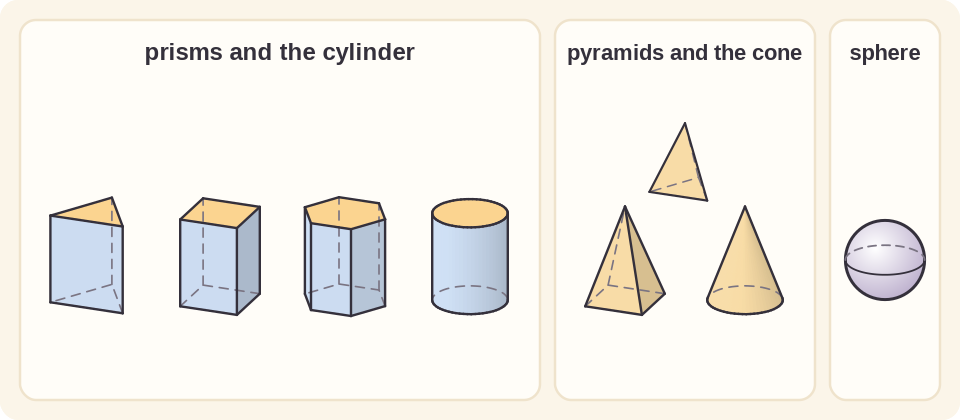
A prism has two equal, parallel bases joined by rectangles; a cylinder is like a prism with circles for bases. A pyramid has one base and triangles that meet at a point; a cone is like a pyramid with a circle for its base. A sphere belongs to neither family.
A prism whose base has n sides has n side faces and 2 bases: n + 2 faces. It has n edges around each base and n going up: 3n edges. It has n corners on each base: 2n vertices. A hexagonal prism has 8 faces, 18 edges and 12 vertices.
Slicing a box
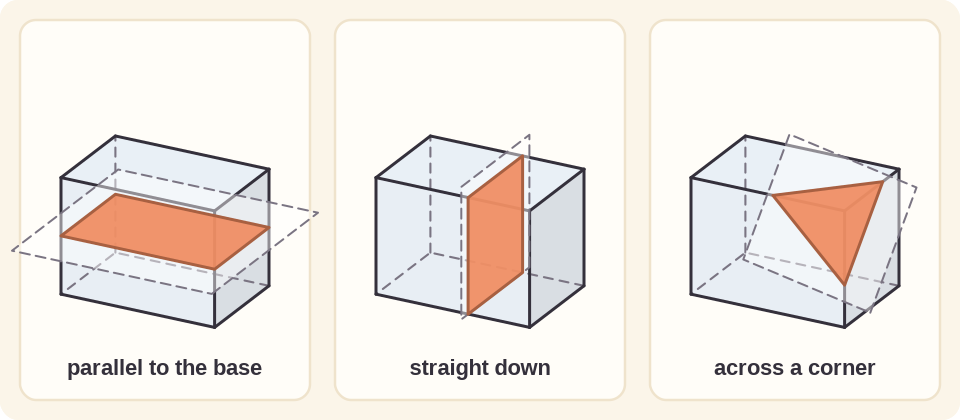
A cross-section is the flat shape you see where a solid is cut by a flat slice.
Slice a box parallel to its base and you get a rectangle just like the base. Slice it straight down, parallel to a side, and you get a rectangle as tall as the box. Cut off a corner and you get a triangle.
Slicing a pyramid and a cylinder
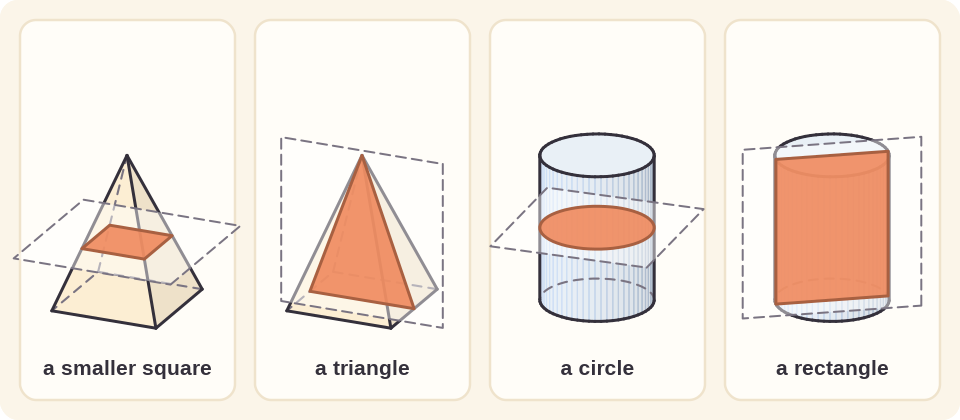
Slice a square pyramid parallel to its base and you get a smaller square: the higher the slice, the smaller the square. Slice it straight down through its top and you get a triangle.
A cylinder sliced parallel to its bases gives a circle the size of a base, and sliced straight down through its middle it gives a rectangle. That is also why a can lying on its side looks like a rectangle from above.
Try it at home
- With an adult's help, slice a block of cheese straight across, straight down and across a corner.
- Press each cut face on paper and trace around it.
- Can you make a cut whose face is a triangle?
Words in this lesson
- prism - a solid with two equal, parallel bases joined by rectangles.
- pyramid - a solid with one base and triangles that meet at a point.
- cross-section - the flat shape where a solid is cut by a flat slice.
Big idea
A cross-section is the shape of a flat cut: a prism or cylinder sliced parallel to its base gives the base again, and a pyramid gives a smaller copy of its base.