Triangles from Three Sides
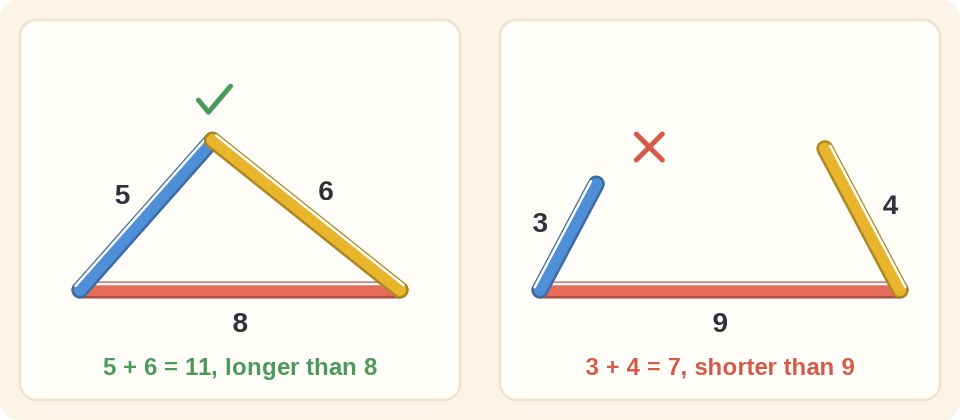
Sam has three straws, 3 cm, 4 cm and 9 cm long. However he turns them, the ends won't meet. Can any three lengths make a triangle?
Two sides together, longer than the third
Lay the 9 cm straw down and stand the other two on its ends. The 3 cm and 4 cm straws together reach only 7 cm, so their tips can never meet.
Now try 5, 6 and 8 cm. 5 + 6 = 11, which is more than 8, so the tips meet and make a triangle.
In every triangle, any two sides together are longer than the third. To test three lengths, one sum is enough: add the two shorter ones and check that they are longer than the longest.
If the sum is exactly equal, like 3, 4 and 7, the two short straws lie flat along the long one, and there is still no triangle.
Drawing it with a compass
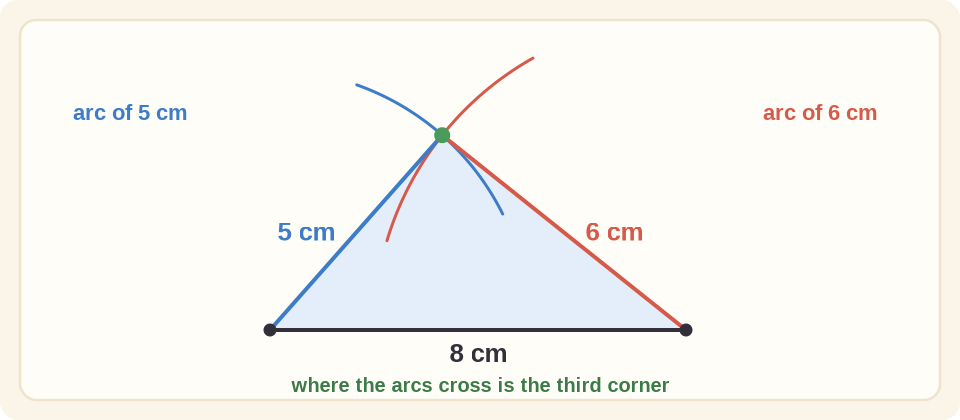
To draw a triangle with sides of 8 cm, 5 cm and 6 cm, draw the 8 cm side first. Open a compass to 5 cm and draw an arc from one end. Open it to 6 cm and draw an arc from the other end.
Where the two arcs cross is the third corner. Join it to both ends. If the two short sides were too short, the arcs would never cross: the compass shows the rule too.
Only one triangle
Three sides that work make exactly one triangle. Anyone who draws 5, 6 and 8 gets a copy of yours, maybe turned or flipped, with the same angles.
That is why a frame of three bars can't wobble, and why bridges and roofs are full of triangles. A frame of four bars can be pushed out of shape.
Try it at home
- Cut strips of card 3, 4, 5, 7 and 9 cm long.
- Take three at a time and see whether they make a triangle. Keep a table.
- Check each try with the rule: are the two shorter ones together longer than the longest?
Words in this lesson
- compass - a tool for drawing circles and arcs of a chosen radius.
Big idea
Three lengths make a triangle only if the two shorter ones together are longer than the longest, and then they make exactly one triangle.