Percent Increase and Decrease
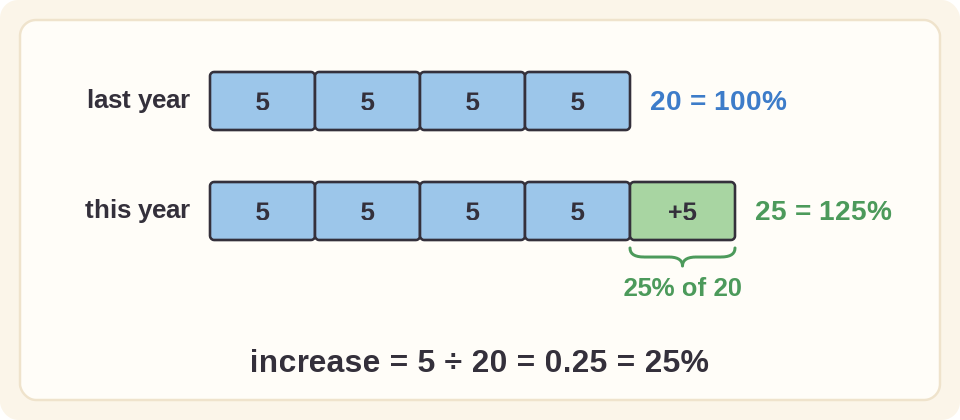
A school club had 20 members last year and has 25 this year. It grew by 5 members, but by what percent?
Change out of the original
A percent increase says how big a rise is compared with the amount you started with, the original amount.
The club grew by 25 − 20 = 5 members. The original was 20. So the increase is 5 out of 20: 5 ÷ 20 = 0.25 = 25%.
The club is now 125% of what it was: the old 100% plus 25% more.
Percent decrease
A percent decrease works the same way, down. A jacket's price drops from 80 dollars to 60. It went down 20 dollars, and 20 ÷ 80 = 0.25, a 25% decrease.
In both cases: percent change = change ÷ original × 100%.
Always of the original
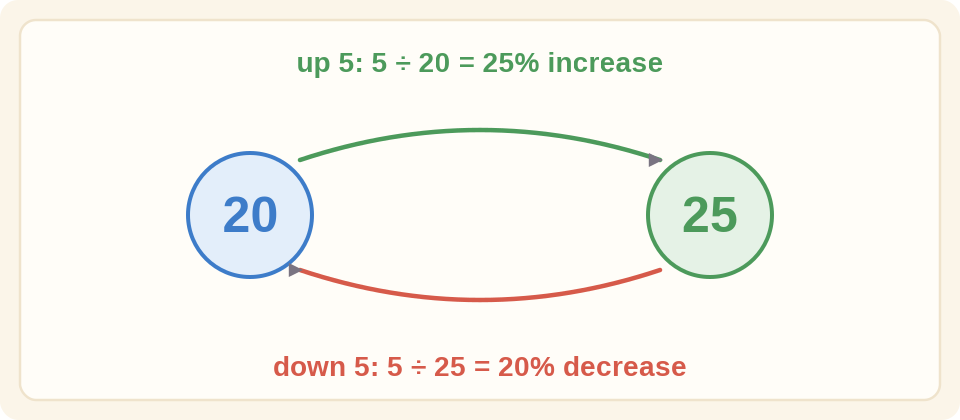
Turn the club story around: 25 members down to 20 is a drop of 5, out of an original 25. That is 5 ÷ 25 = 20%, not 25%.
The same 5 members are a 25% rise from 20 but a 20% fall from 25, because the original is different.
Careful
Divide by the amount you started with, even when the story names the new amount first.
Try it at home
- Find the price of something your family buys often, now and a year ago (an old receipt helps).
- Find the change and divide it by the old price.
- What was the percent increase or decrease?
Words in this lesson
- original amount - the amount before the change; a percent change is always out of it.
- percent increase - the rise as a percent of the original.
- percent decrease - the drop as a percent of the original.
Big idea
Percent change is the change divided by the original amount, never by the new one.