Simulations
A cereal box has a prize in 1 out of 6 boxes, at random. About how many boxes will you have to buy to get a prize? You could buy lots of cereal to find out, or you could roll a die.
Act it out with chance
A simulation acts out a chance situation with a simpler experiment that has the same probabilities. The prize is in of the boxes, and a die shows a 6 with probability . So let a roll of 6 mean a prize and any other roll mean no prize.
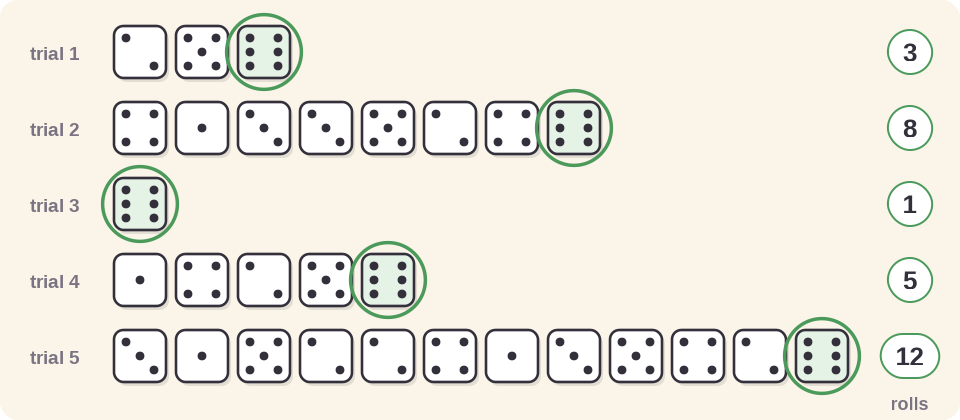
One trial is rolling until a 6 comes and counting the rolls. Do many trials. In 10 trials the counts were 3, 8, 1, 5, 12, 2, 6, 4, 9 and 3. Their mean is 53 ÷ 10, about 5 boxes.
Matching the probability
Pick a tool whose outcomes match the probability. A coin works for 1 out of 2. A die works for 1 out of 6, or 2 out of 6 for one third. A spinner can be cut into any parts.
For a probability like 40%, use random digits 0 to 9, each equally likely. Let 0, 1, 2 and 3 mean yes: 4 of 10 digits, 40%. A calculator or a computer can give random digits.
A simulation with digits
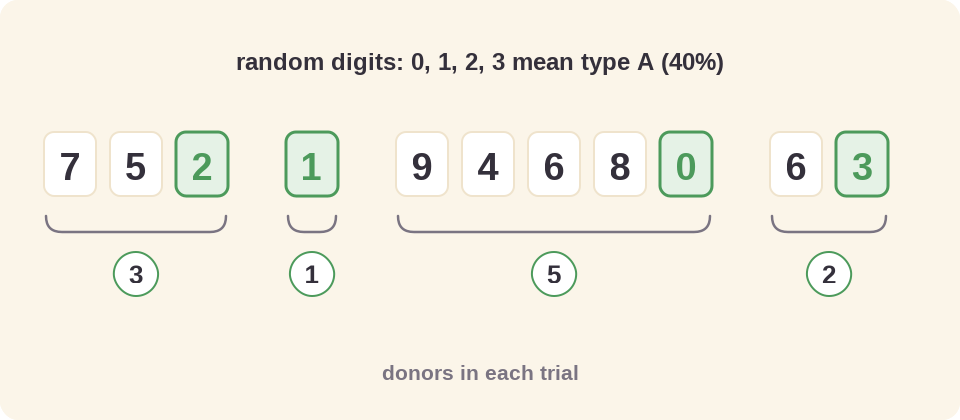
40% of people who give blood have type A. About how many donors does a blood bank need to find one with type A? Let 0 to 3 be type A and 4 to 9 not.
Read a row of random digits and stop at the first 0, 1, 2 or 3: 7, 5, 2 is a trial of 3 donors. In 20 trials, 6 needed at least 4 donors, so estimate the probability of that as 0.3.
Try it at home
- A player makes half her shots. Use a coin to simulate 5 shots: heads is a basket.
- Do 20 trials and write how many baskets each one had.
- Estimate the probability of 4 or more baskets in 5 shots.
Words in this lesson
- simulation - an experiment that acts out a chance situation with the same probabilities.
- trial - one run of a simulation.
- random digits - the digits 0 to 9 chosen so that each is equally likely.
Big idea
To estimate a hard probability, act it out many times with a coin, a die, a spinner or random digits that have the same probabilities.