Congruent Figures
Two puzzle pieces look alike, but one is upside down. Are they the same shape? Move one and see if it covers the other exactly.
Laid exactly on top
Two figures are congruent when one can be moved exactly onto the other by translations, reflections and rotations, one move or several. Where they sit and which way they face doesn't matter. Their shape and size do.
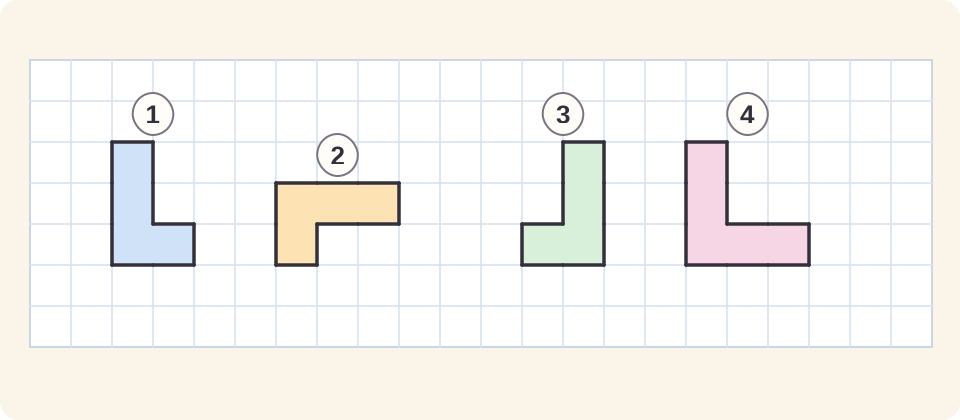
A turn lays shape 2 on shape 1, and a flip lays shape 3 on it: both are congruent to it. Shape 4 has a longer foot, so it never fits. The sign ≅ means "is congruent to".
Matching parts
When one triangle is laid on another, the parts that land on each other are corresponding parts, and they are equal.
Write a congruence with matching corners in the same order. △ABC ≅ △DEF says A goes on D, B on E and C on F. So side BC corresponds to side EF, and angle C to angle F.
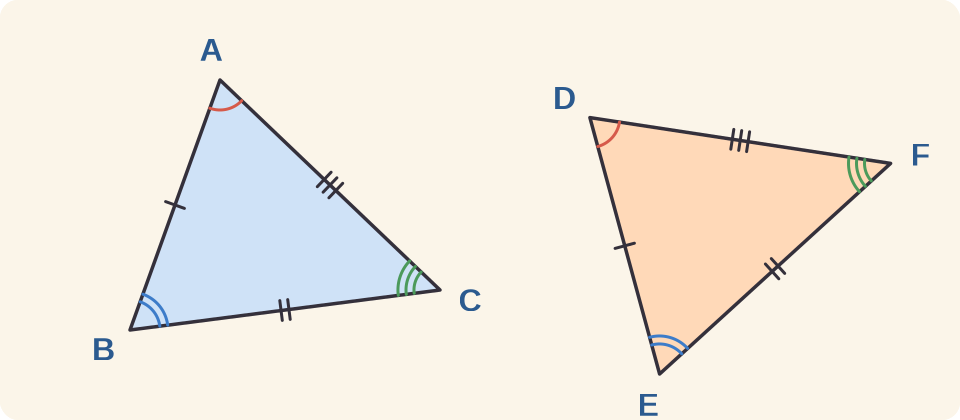
Drawings mark matching parts alike: the same ticks on sides, the same arcs on angles.
Order matters
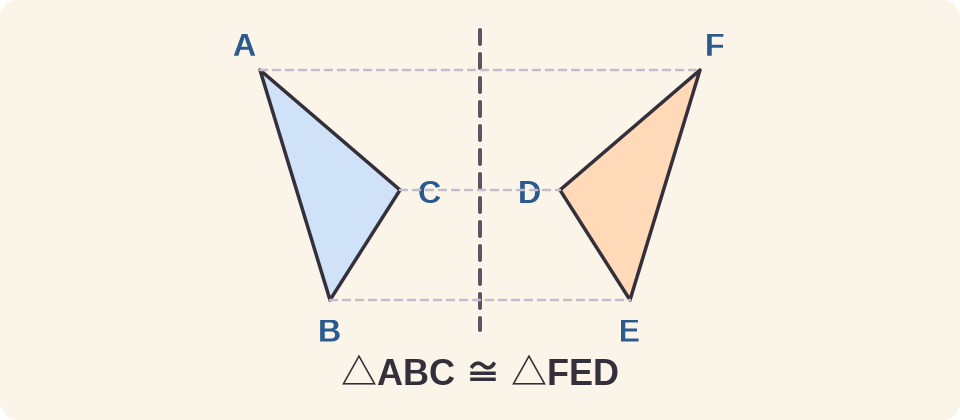
Triangle ABC is flipped in a line. A lands on F, B on E and C on D. So we write △ABC ≅ △FED. Writing △ABC ≅ △DEF would match B with E but A with D, which is wrong.
Equal sides are not enough
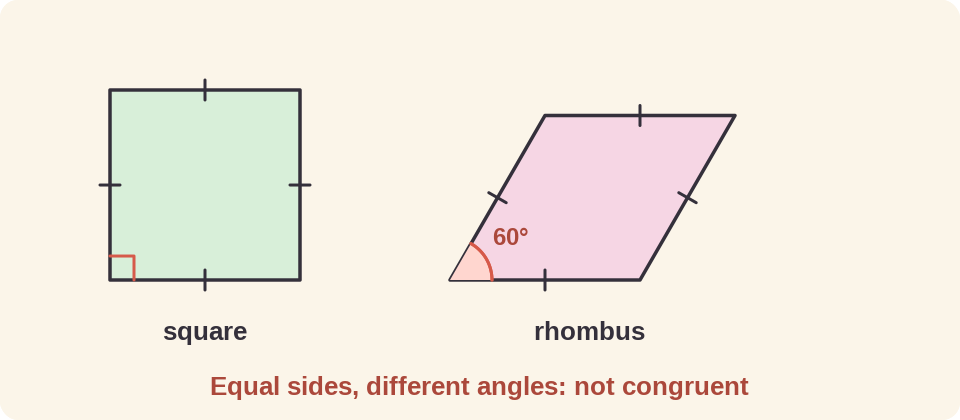
A square and a rhombus can both have four sides of 5 cm. But a rhombus is a square pushed over: its angles aren't right angles, so no move lays one on the other. For four sides or more, check the angles too.
Try it at home
- Cut two triangles out of paper by folding a sheet and cutting through both layers.
- Name the corners of one A, B, C and lay it on the other in a new position, flipped or turned.
- Name the other's corners D, E, F so that △ABC ≅ △DEF is written in the right order.
Words in this lesson
- congruent - able to be moved exactly onto each other by slides, flips and turns: the same shape and size.
- corresponding parts - the sides and angles that land on each other when one figure is laid on the other.
Big idea
Congruent figures can be laid exactly on each other by moves; write the corners in matching order, and remember equal sides alone don't make two quadrilaterals congruent.