Solving Two-Step Inequalities
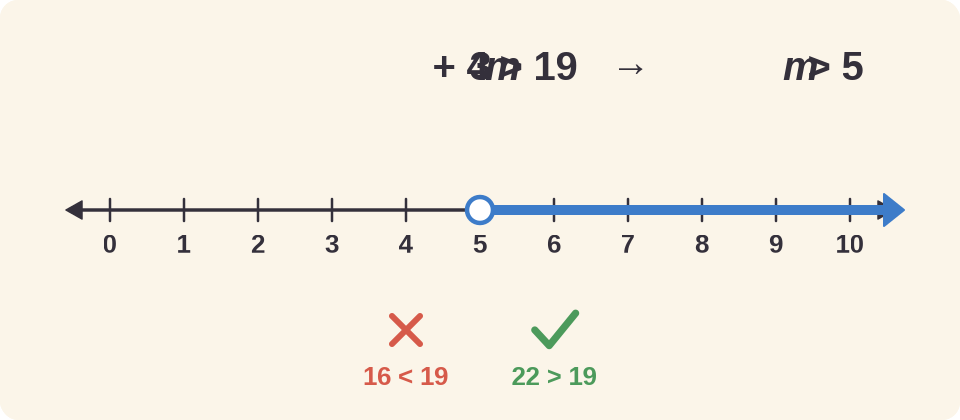
A taxi charges $4 to start and $3 for each mile. Which trips cost more than $19? The miles m must make true. Inequalities like this are solved almost like equations.
Solve like an equation
Take 4 from both sides: . Divide both sides by 3: . Adding, subtracting, and multiplying or dividing by a positive number keep an inequality true, just as they keep a balance level.
So every trip longer than 5 miles costs more than $19. The answer is not one number but a solution set: all the numbers that make the inequality true.
Graph the solution set
On a number line, an open dot at 5 shows that 5 itself is not in the set, and a thick ray to the right shows every number greater than 5.
Test a number on each side to be sure. 6 is in the set: 3 × 6 + 4 = 22, and 22 > 19. 4 is not: 3 × 4 + 4 = 16, which is less than 19.
At most and at least
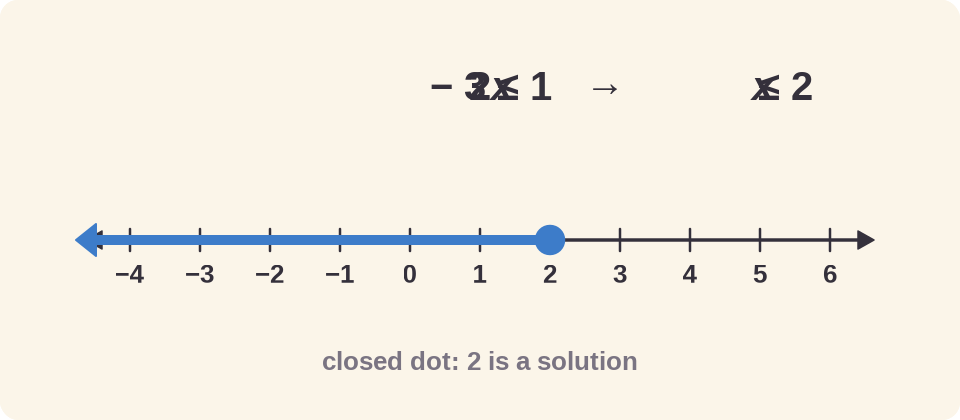
With or , the boundary number belongs to the set, so its dot is closed. : add 3, , divide by 2, .
Fractions and decimals are fine too: gives , so .
Try it at home
- Find the prices of a taxi or a bike rental near you: a starting fee and a price per mile or hour.
- Write an inequality for the trips that cost less than 20 dollars.
- Solve it, graph it, and test one number inside and one outside the set.
Words in this lesson
- solution set - all the numbers that make an inequality true, often shown as a ray on a number line.
- boundary - the number where the solution set starts: an open dot if it is left out, a closed dot if it is in.
Big idea
Solve a two-step inequality like an equation, then graph the set with an open or closed dot and test a number on each side.