Circumference and Diameter
Wrap a string around a plate, then lay it across the plate. The string that went around is a little more than three times as long. Try a coin or a bike wheel: always the same.
Parts of a circle
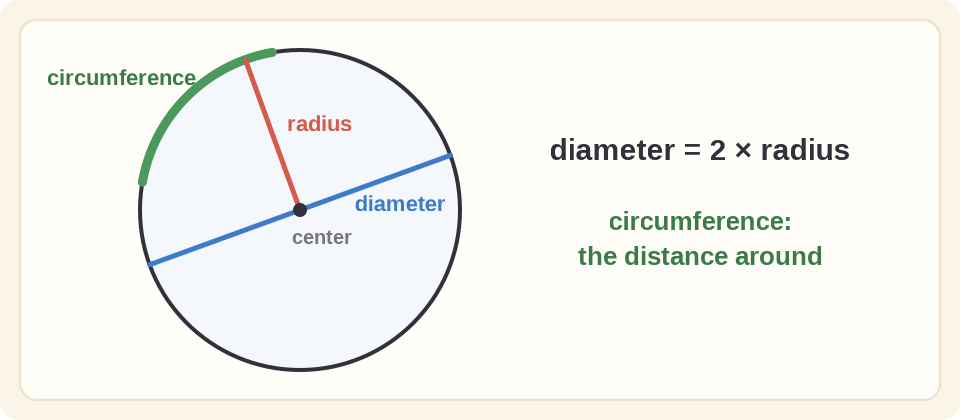
Every point of a circle is the same distance from its center. That distance is the radius. The diameter goes straight across through the center, so it is two radii. The circumference is the distance around the circle.
Always about 3.14
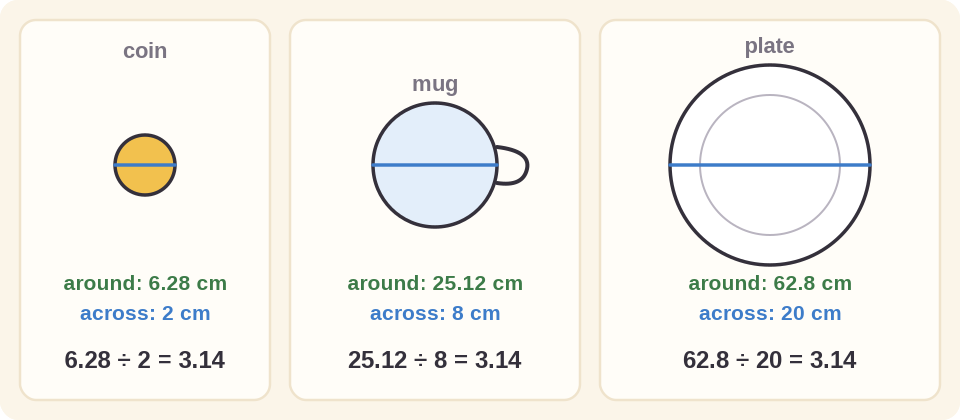
Measure any circle and divide its circumference by its diameter. A plate 20 cm across has a circumference of about 62.8 cm, and 62.8 ÷ 20 = 3.14. A coin, a wheel, the Earth's equator: the answer is always about 3.14.
This number is called pi, written π. Its digits never end and never repeat: 3.14159265... We use 3.14, or the fraction , which is very close.
The formulas
So the circumference is π times the diameter: . The diameter is two radii, so also .
A round pond 10 m across has a path around it about 3.14 × 10 = 31.4 m long. A circle with a radius of 7 cm has a circumference of 2 × × 7 = 44 cm.
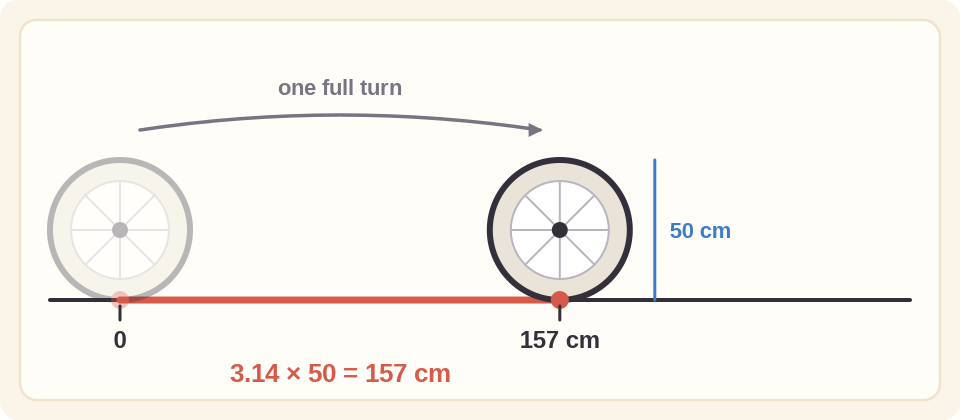
A wheel 50 cm across rolls 3.14 × 50 = 157 cm in one full turn, since every point of its edge touches the ground once.
Going back: a circle with a circumference of 31.4 cm has a diameter of 31.4 ÷ 3.14 = 10 cm.
Careful
Check whether you were given the radius or the diameter. With a radius, double it first, or use 2πr.
Try it at home
- Find three round things at home: a plate, a jar lid and a coin.
- Measure around each with a string and across each with a ruler.
- Divide the distance around by the distance across. What do you notice?
Words in this lesson
- radius - the distance from the center of a circle to its edge.
- diameter - the distance straight across a circle through its center: two radii.
- circumference - the distance around a circle.
- pi (π) - the circumference of any circle divided by its diameter, about 3.14.
Big idea
Every circle's circumference is π times its diameter, and π is about 3.14: C = πd = 2πr.