Tessellations
Look at a tiled floor, a brick wall or a honeycomb. Copies of one shape cover the whole surface with no gaps and no overlaps. Which shapes can do that, and why?
Covering with congruent copies
A tessellation, or tiling, covers a flat surface with shapes, leaving no gaps and no overlaps. When every tile is a copy of one shape, all the tiles are congruent: a translation or a rotation moves any tile onto any other.
Squares, equilateral triangles and regular hexagons all tile. So do rectangles, which is why bricks are made that way.
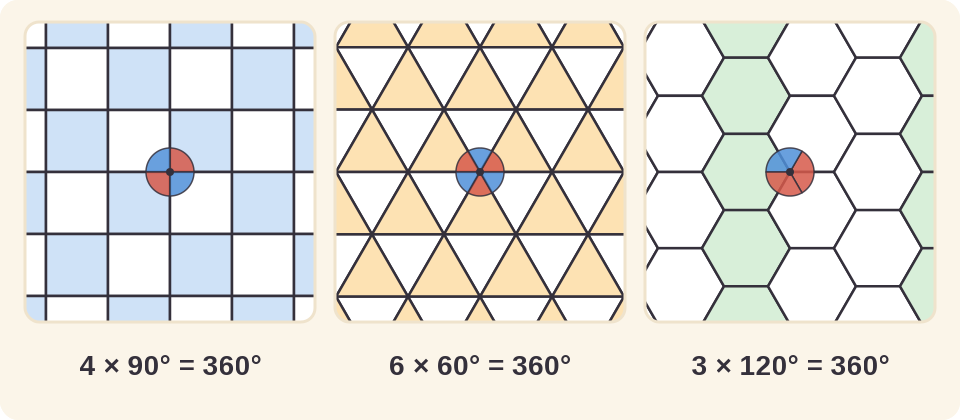
360° at every point
Where corners of tiles meet, their angles must fill the whole turn around the point: 360°. Four squares give 4 × 90° = 360°, six equilateral triangles 6 × 60° = 360°, three hexagons 3 × 120° = 360°.
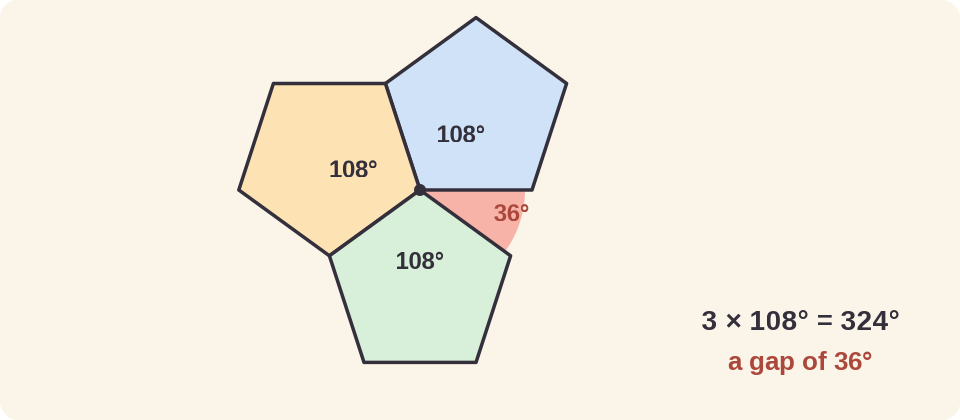
A regular pentagon has angles of 108°. Three of them make 324°, which leaves a gap, and four make 432°, which overlap. So regular pentagons can't tile a floor by themselves.
Any triangle, any quadrilateral
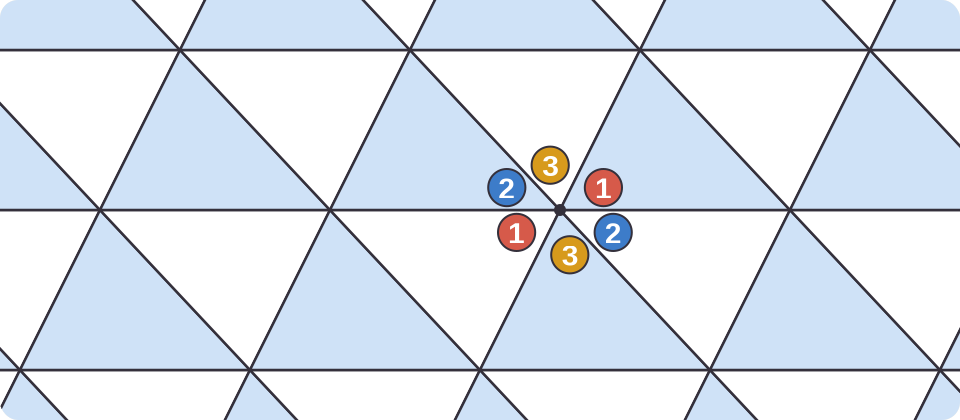
Even a triangle with no equal sides tiles. Turn a copy half a turn about the middle of one side, and the two make a parallelogram. Parallelograms fill rows, and rows fill the floor.
At each meeting point, six corners meet, two of each angle. A triangle's angles add up to 180°, so 2 × 180° = 360°.
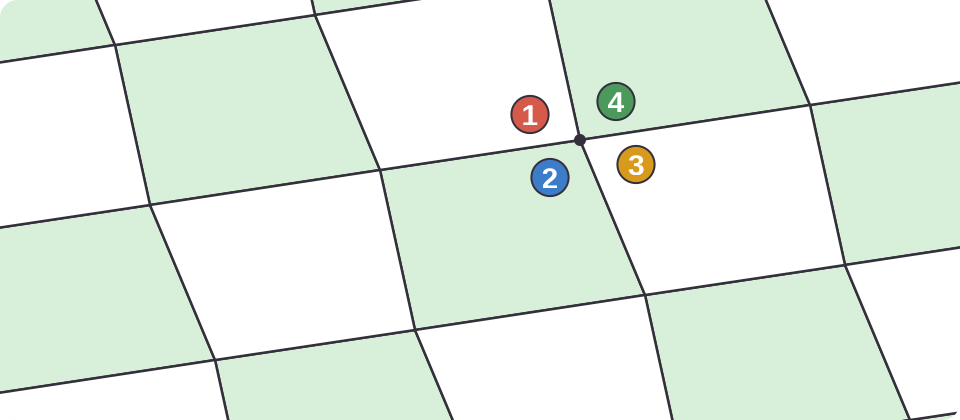
Any quadrilateral tiles too, by half-turns about the middles of its sides. Its four angles add up to 360°, and at each point one of each meets.
Try it at home
- Cut ten copies of one triangle from card by stacking the sheets.
- Lay them on a table so they cover it with no gaps, turning copies half a turn.
- Find a point where six corners meet. Which angles are they?
Words in this lesson
- tessellation - a covering of a flat surface with shapes, leaving no gaps and no overlaps; also called a tiling.
- regular polygon - a polygon whose sides are all equal and whose angles are all equal.
Big idea
A tessellation covers a surface with congruent copies; it works when the angles meeting at each point add up to 360°, so any triangle and any quadrilateral tile, but a regular pentagon doesn't.