Tree Diagrams
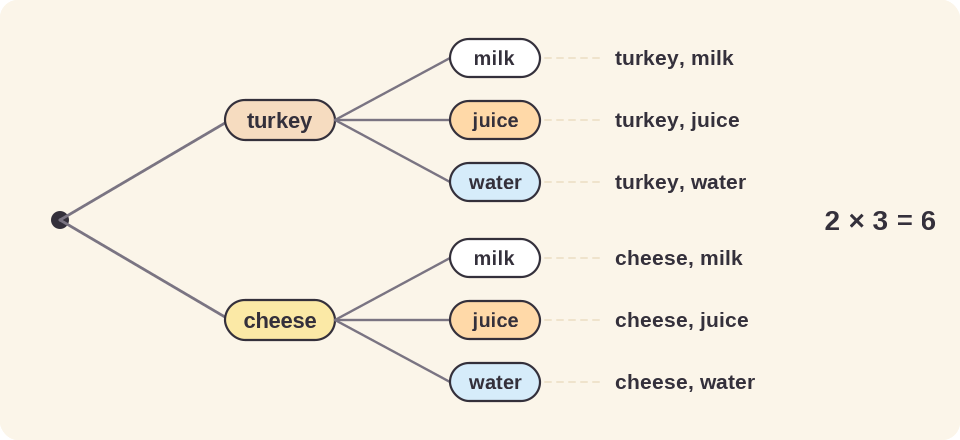
The school lunch is a turkey or a cheese sandwich, with milk, juice or water, and you get one of each at random. How many different lunches are there? A drawing that branches like a tree shows them all.
Branch by branch
A tree diagram shows a sample space step by step. The first step gets one branch for each outcome: turkey, cheese. From the end of each branch, the second step gets a branch for each of its outcomes: milk, juice, water.
Each path from the start to an end is one outcome. Here there are 2 × 3 = 6 paths, so 6 lunches.
If each lunch is equally likely, the probability of a cheese sandwich with juice is .
Three coins
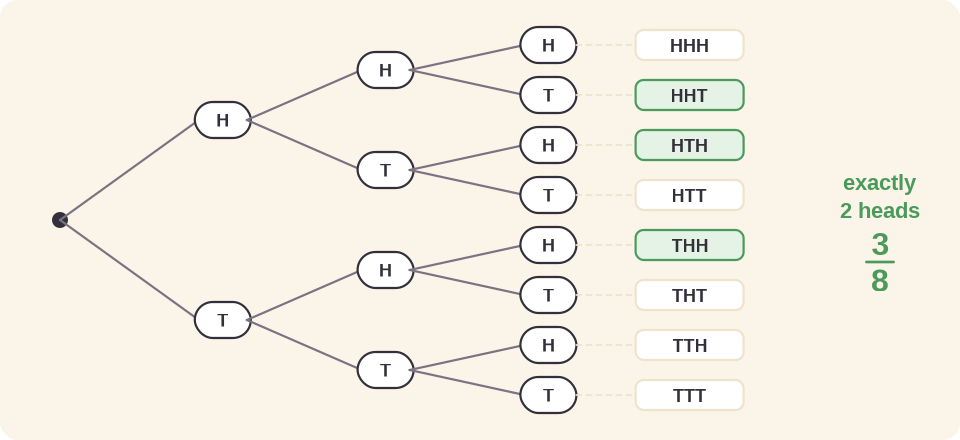
Toss three coins. The first coin branches into H and T; each of those into H and T; each of those again. That makes 2 × 2 × 2 = 8 paths.
Exactly two heads happens on 3 paths: HHT, HTH and THH. So its probability is .
At least two heads adds HHH: = .
Multiply to count
In each step, every branch gets the same number of new branches. So the number of outcomes is the product of the numbers at each step. A coin and a die: 2 × 6 = 12. Three coins: 2 × 2 × 2 = 8.
Try it at home
- Pick 2 shirts and 3 pairs of pants or skirts from your closet.
- Draw a tree diagram of all the outfits.
- How many are there? Which multiplication gives the same number?
Words in this lesson
- tree diagram - a drawing that shows a sample space step by step, with a branch for each outcome.
- path - a route from the start of a tree diagram to one end: one outcome.
Big idea
In a tree diagram each path is one outcome; count the paths in the event and divide by all the paths.