Equally Likely Outcomes
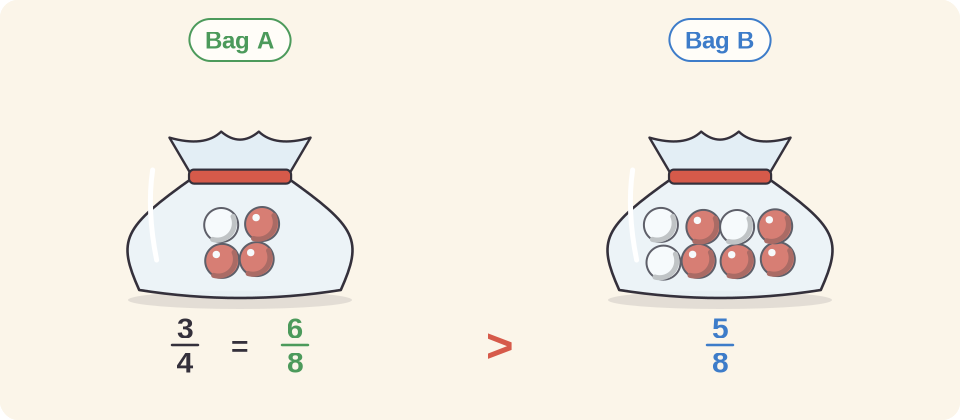
Bag A has 3 red beads out of 4. Bag B has 5 red beads out of 8. You may take one bead without looking, and red wins a prize. Bag B has more red beads. Should you pick it?
Favorable over possible
Each way an experiment can come out is an outcome. When all the outcomes have the same chance, they are equally likely: the six faces of a fair die, the two sides of a coin, the beads in a well-mixed bag.
Then the probability of an event is the number of outcomes in it, the favorable outcomes, divided by the number of possible outcomes.
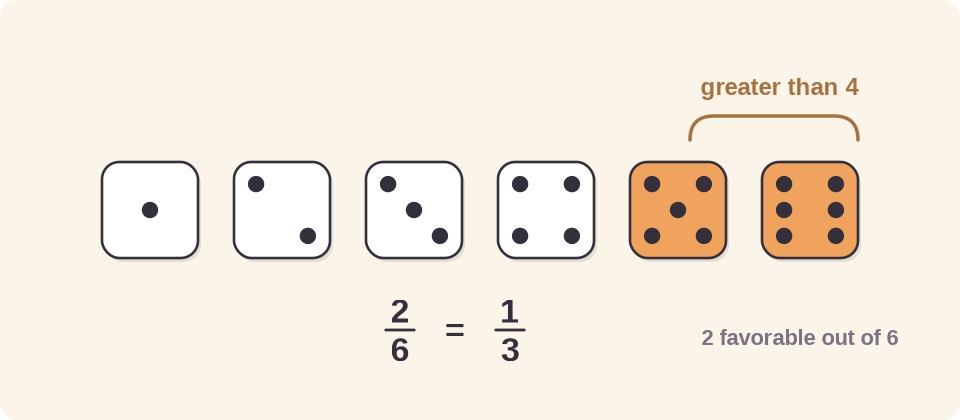
A die is rolled. Which numbers are greater than 4? Only 5 and 6: 2 favorable outcomes out of 6. So the probability is = .
Compare fractions, not counts
Now the bags. Bag A gives red with probability . Bag B gives red with probability .
To compare, write them with the same denominator: = , and is more than . So red is more likely from Bag A, though Bag B has more red beads. What matters is the share of red, not the number.
Only when they are equally likely
The rule works only for equally likely outcomes. A soccer game can end in a win, a loss or a tie, but that does not make a win : a strong team wins far more often.
Before you count, ask: does each outcome have the same chance?
Try it at home
- Put 3 red and 1 white bead in one cup, and 5 red and 3 white in another.
- Write the probability of red from each cup as a fraction with denominator 8.
- Draw 20 times from each cup, putting the bead back each time. Which cup gave red more often?
Words in this lesson
- outcome - one way an experiment can come out.
- equally likely - having the same chance of happening.
- favorable outcomes - the outcomes in the event you are asking about.
Big idea
When outcomes are equally likely, the probability is favorable outcomes ÷ possible outcomes, and two probabilities are compared by their fractions.