Rewriting Expressions to Show Their Meaning
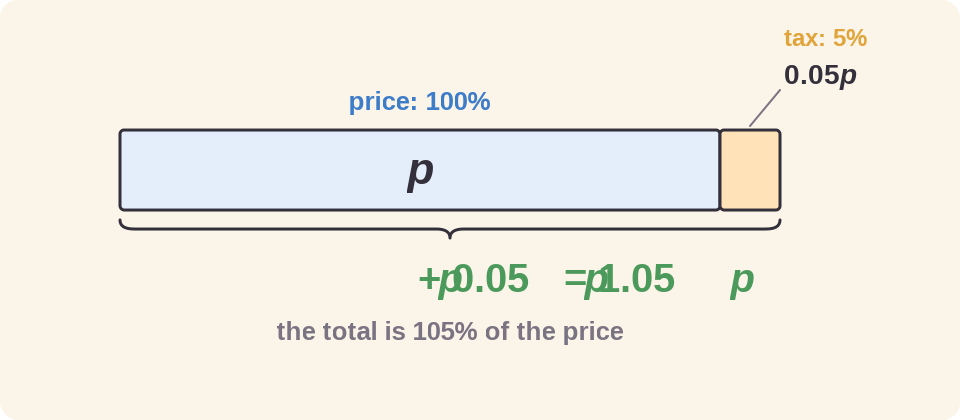
A shirt costs p dollars, and a 5% sales tax is added. You could write the total as or as . Both are right. Each one tells you something the other hides.
Two forms, two stories
says: the price, plus 5% of the price. says: the total is 105% of the price. They are equal because , and .
A 20% discount works the same way: . Paying 80% of the price is the same as taking off 20%.
Rewriting a perimeter
The perimeter of a rectangle is , or, factored, . The first form says: two lengths and two widths. The second says: go once along a length and a width, then double it.
Neither form is better. Pick the one that helps you think about the question.
Putting in a value
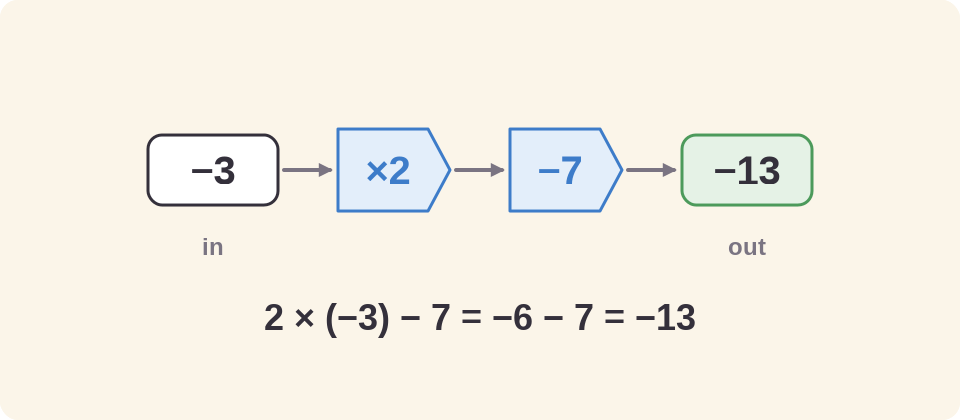
To evaluate an expression, put the number in place of the letter, in parentheses if it is negative. For when : 2 × (−3) − 7 = −6 − 7 = −13.
Fractions work too. For when : 4 × + 1 = 2 + 1 = 3.
If an expression is long, simplify it first. is , which is just 12, whatever x is.
Try it at home
- Find a price tag at home or in an ad.
- Work out the price with a 6% tax two ways: p + 0.06p and 1.06p.
- Then find the price after a 15% discount, written as 0.85p.
Words in this lesson
- evaluate - to find an expression's value by putting a number in place of the letter.
- equivalent expressions - expressions that give the same value for every number put in, such as p + 0.05p and 1.05p.
Big idea
Rewriting an expression in another shape can show what it means, like 1.05p showing a total is 105% of the price.