Commission and Simple Interest
Some people are paid a percent of what they sell. Some money in a bank earns a percent every year. Both are percents of an amount, again and again.
Commission
A commission is pay that is a percent of the sales a person makes.
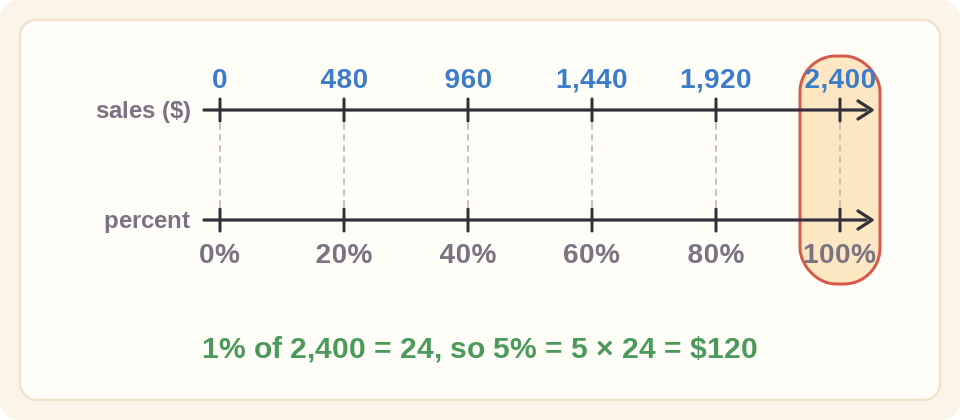
Sam sells bikes and earns 5% commission. In a week he sells $2,400 of bikes. His commission is 0.05 × 2,400 = $120.
Going backwards: if Sam earned $90, his sales were 90 ÷ 0.05 = $1,800.
Simple interest in words
When you put money in a savings account, the bank pays you for keeping it there. That pay is interest. The money you put in is the principal.
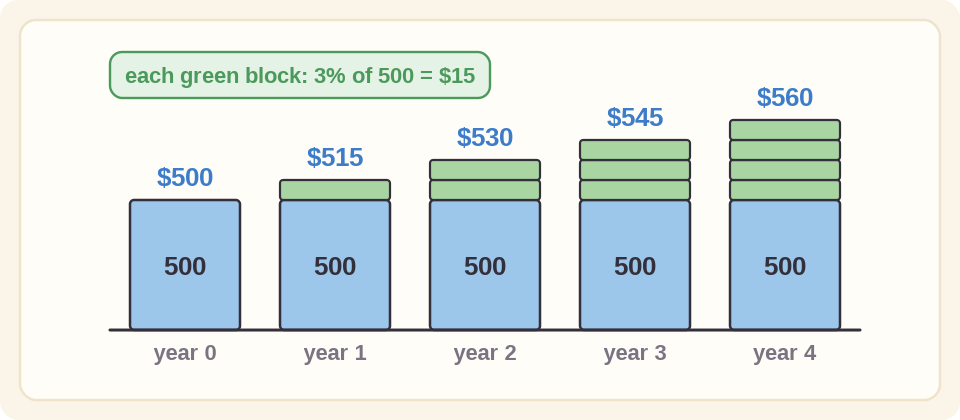
With simple interest, each year you earn the same percent of the principal. Put $500 in at 3% a year: each year earns 0.03 × 500 = $15.
After 4 years: 4 × 15 = $60 of interest, and the account holds $560.
As a formula
Interest = principal × rate × time, or , with the rate as a decimal and the time in years: .
Borrowing works the same way, but then you pay the interest. Borrow $1,000 at 6% for 2 years and you pay dollars of interest.
Try it at home
- Find the interest rate of a savings account on a bank's website.
- Work out the simple interest on 100 dollars for 1 year and for 5 years.
- How long would it take to earn 100 dollars of interest?
Words in this lesson
- commission - pay that is a percent of sales.
- principal - the money put in or borrowed.
- simple interest - interest that is the same percent of the principal every year: I = Prt.
Big idea
Commission and simple interest are both a percent of an amount; simple interest earns it again every year.