Probability Models
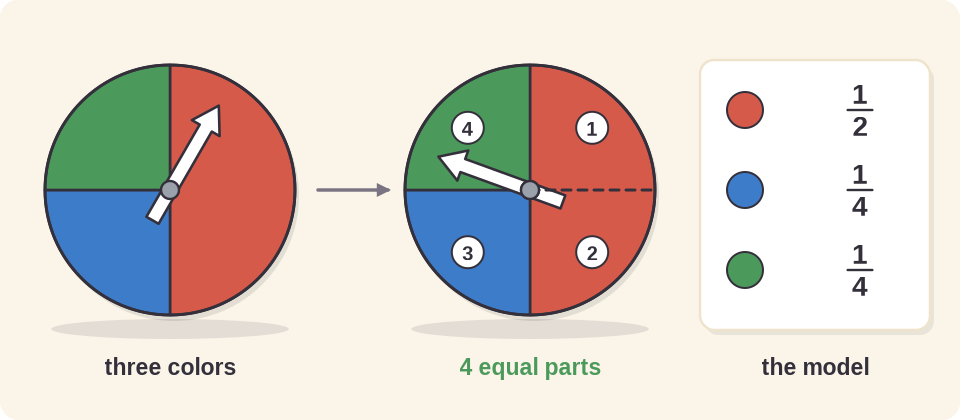
A spinner is half red, a quarter blue and a quarter green. It has three colors, so is the chance of blue 1 out of 3? Spin it a hundred times and blue comes far less often than red. Something about that guess is wrong.
A list of outcomes and their probabilities
A probability model lists every outcome of an experiment with its probability. The probabilities of all the outcomes add up to 1.
A model in which every outcome has the same probability is a uniform model. A fair die is one: each face is , and six sixths make 1.
Cut into equal parts
The spinner's colors are not equally likely, so its model is not uniform. To find the probabilities, cut it into equal parts. Cut the red half in two: now there are 4 equal parts, 2 red, 1 blue and 1 green.
So red is = , blue is and green is . Check: + + = 1. Blue is , not .
A model from data
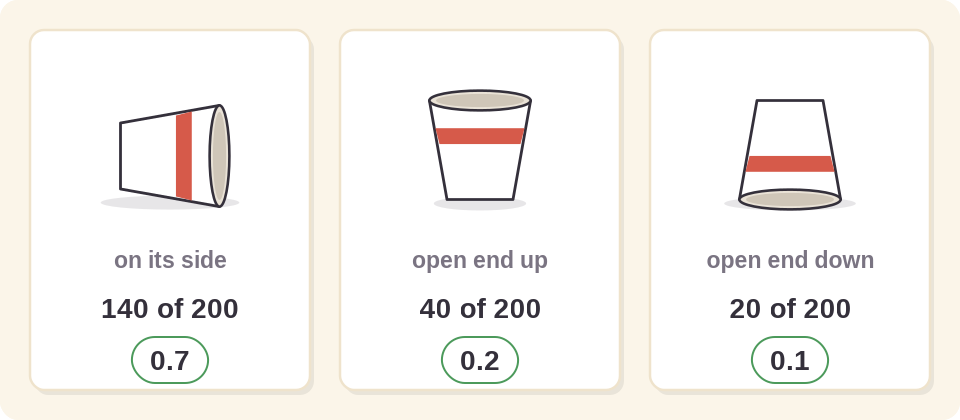
Some things have no equal parts to count. Toss a paper cup and it can land on its side, open end up or open end down. These are not equally likely.
Toss it 200 times and count: side 140, up 40, down 20. That gives a model: side 0.7, up 0.2, down 0.1. They add up to 1, and the model says landing on its side is by far the most likely.
Careful
Different outcomes are not always equally likely. Count equal parts, not colors or names.
Try it at home
- Toss a paper cup 50 times and tally side, up and down.
- Divide each count by 50 to make a model.
- Do your three probabilities add up to 1? Which outcome is most likely?
Words in this lesson
- probability model - a list of all the outcomes of an experiment and the probability of each.
- uniform model - a model in which every outcome has the same probability.
Big idea
A probability model gives every outcome a probability, all adding up to 1; read a spinner with unequal parts by cutting it into equal parts.