Signed Number Stories
Temperatures fall, divers sink, and money is spent. When a story has amounts that go down, negative numbers make the arithmetic simple: write each change with its sign.
A falling temperature
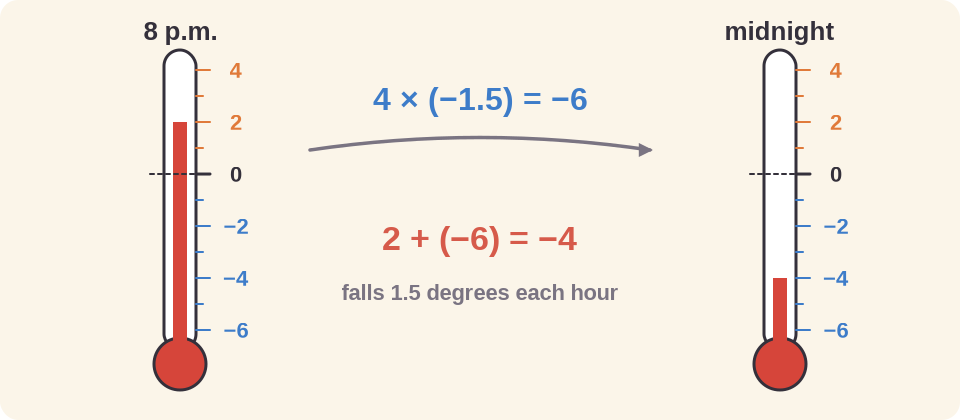
At 8 p.m. it is 2 degrees, and the temperature falls 1.5 degrees every hour. What is it at midnight, 4 hours later?
Each hour is a change of −1.5, so 4 hours is 4 × (−1.5) = −6. The temperature is 2 + (−6) = −4 degrees.
A rising diver
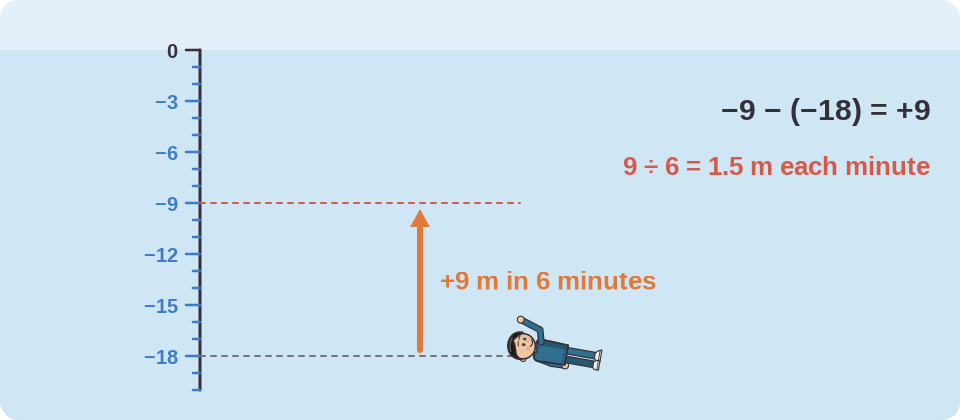
A diver is at −18 meters and rises at a steady rate to −9 meters in 6 minutes. What is her rate?
Her change is −9 − (−18) = 9 meters. Per minute that is 9 ÷ 6 = 1.5 meters, going up: +1.5 meters per minute.
Sharing a debt
Four friends share a restaurant bill of $45.60 equally. Each person's money changes by −45.60 ÷ 4 = −11.40 dollars.
Check the size of an answer with rounded numbers: −45.60 ÷ 4 is about −48 ÷ 4 = −12, so −11.40 makes sense. And check the sign with the story: paying makes your money go down.
Try it at home
- Find a weather forecast for a cold night with hourly temperatures.
- Find the change from one hour to the next as a signed number.
- Use the average change per hour to predict the temperature two hours after the forecast ends.
Words in this lesson
- rate of change - how much an amount changes for each unit of time, with a sign: −1.5 degrees per hour.
- estimate - an answer worked out with rounded numbers, to check the real answer is about right.
Big idea
In a story, write each change as a signed number, then multiply, divide and add, and check the sign and size against the story.