Area of Composite Shapes
A school yard has an odd shape. No single formula fits it, but the formulas you know fit its pieces.
The formulas you know
A rectangle is length × width, a parallelogram base × height, and a triangle half of base × height. A trapezoid, with one pair of parallel sides, is the sum of the parallel sides times the height, halved: . Two copies of it make a parallelogram with base a + b, which is why you halve.
A rhombus has four equal sides, and its two diagonals cross at right angles. Its area is the two diagonals multiplied, then halved, because it fills exactly half of the rectangle around it.
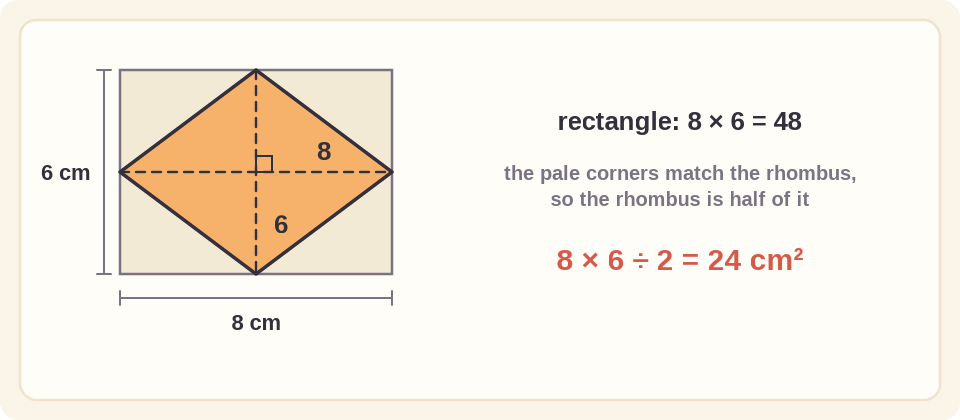
Diagonals of 8 cm and 6 cm give 8 × 6 ÷ 2 = 24 cm². Backwards: a rhombus of 30 cm² with one diagonal of 10 cm has twice its area, 60, equal to 10 times the other diagonal, so that diagonal is 6 cm.
Cut it into pieces
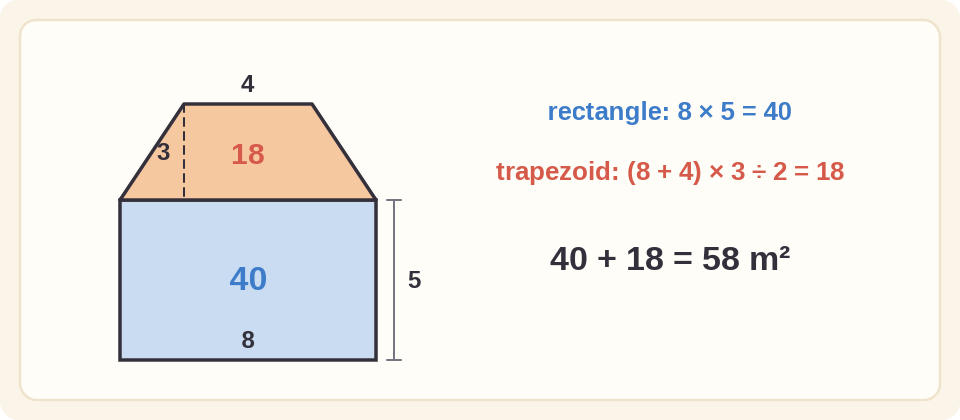
A composite shape is made of simpler shapes, like this rectangle 8 m by 5 m with a trapezoid on top whose parallel sides are 8 m and 4 m and whose height is 3 m.
Rectangle: 8 × 5 = 40 m². Trapezoid: (8 + 4) × 3 ÷ 2 = 18 m². Together: 40 + 18 = 58 m².
Take a piece away
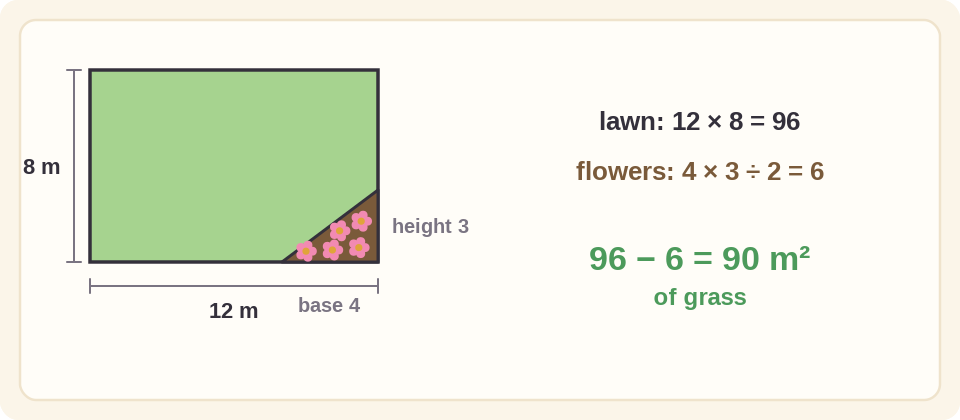
Or start with a big rectangle and subtract the missing part.
A lawn 12 m by 8 m has a triangle-shaped flower bed, base 4 m and height 3 m, in one corner. The grass is 12 × 8 − 4 × 3 ÷ 2 = 96 − 6 = 90 m².
Count every piece once: no gaps, no overlaps.
Try it at home
- Sketch the floor of a room or a yard that is not a plain rectangle.
- Measure it and cut your sketch into rectangles, triangles and trapezoids.
- Find each area and add them.
Words in this lesson
- trapezoid - a four-sided shape with one pair of parallel sides.
- rhombus - a four-sided shape with four equal sides.
- diagonal - a straight line from one corner of a shape to the opposite corner.
- composite shape - a shape made of simpler shapes put together.
Big idea
To find the area of a composite shape, cut it into shapes with formulas and add, or take pieces away from a bigger shape.