Opposites Make Zero
A hydrogen atom has one proton with a charge of +1 and one electron with a charge of −1. Together the atom has no charge at all. Two opposites make zero.
Counters for signed numbers
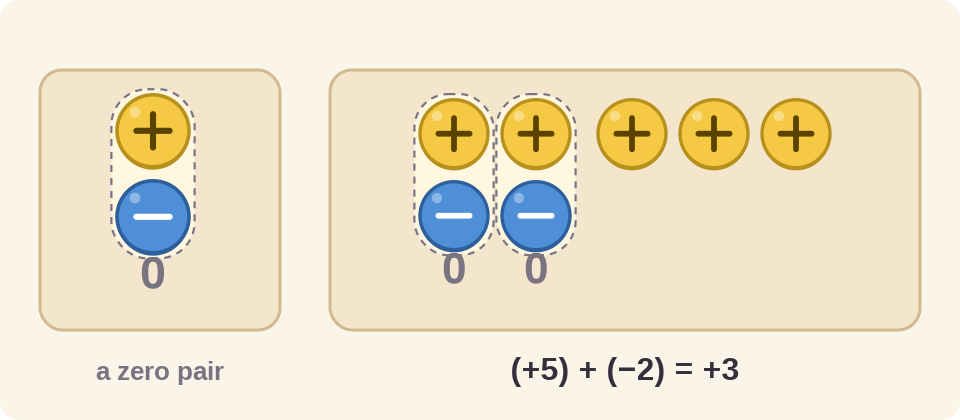
Let a yellow counter stand for +1 and a blue counter for −1. One yellow and one blue together are (+1) + (−1) = 0. That pair is a zero pair.
A zero pair can be added to a pile or taken away from it, and the pile's value does not change.
Cancel the pairs
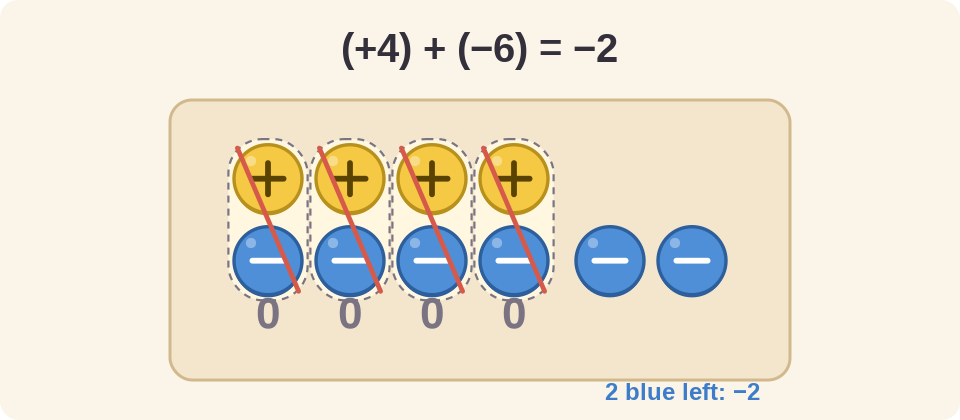
To work out (+4) + (−6), put out 4 yellow counters and 6 blue ones. Match each yellow with a blue: that makes 4 zero pairs, worth 0.
What is left is 2 blue counters. So (+4) + (−6) = −2.
Additive inverses
A number and its opposite are also called additive inverses: 7 and −7, −2.5 and 2.5. Whatever the number, .
In a story, opposites cancel too. Earning 20 dollars and spending 20 dollars leaves your savings where they were.
Try it at home
- Cut 10 squares of yellow paper and 10 of blue (or use two kinds of coins).
- Ask someone to make a pile with both colors without telling you its value.
- Remove zero pairs until one color is left, and say the value of the pile.
Words in this lesson
- zero pair - a +1 and a −1 together; they add to 0.
- additive inverse - a number's opposite; a number plus its additive inverse is 0.
Big idea
A number and its opposite add to 0, so zero pairs can always be removed or added without changing a sum.