Vertical Angles
Two straight roads cross and make four angles at the crossing. Measure one of them, and you can find all the others without a protractor.
Four angles at a crossing
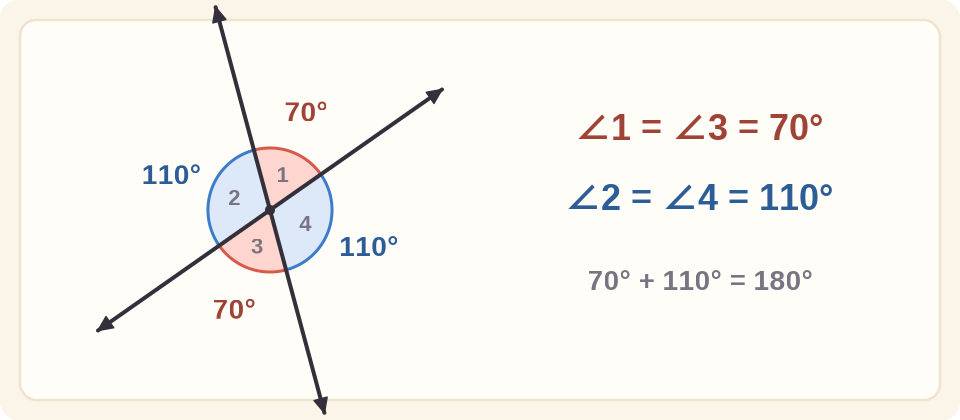
When two straight lines cross, they make four angles. The angles across from each other are vertical angles, and they are always equal. Angles next to each other lie on a straight line, so they are supplementary.
If one angle is 70°, the angle across from it is 70° too. Each angle next to it is 180° − 70° = 110°, and the fourth, across from that one, is also 110°.
Why they are always equal
Measuring a few crossings shows the pattern, but not that it holds for every crossing. A reason that works for all of them, a proof, does.
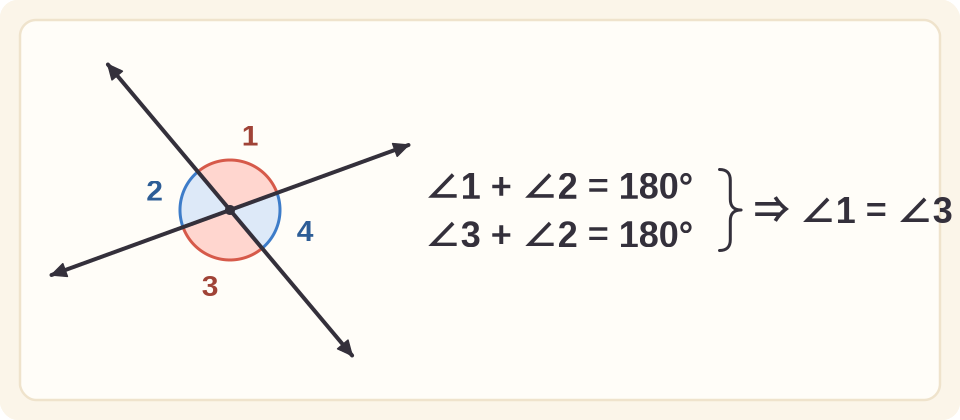
Number the angles 1, 2, 3 and 4 around the crossing. Angles 1 and 2 lie along one line, so ∠1 + ∠2 = 180°. Angles 3 and 2 lie along the other line, so ∠3 + ∠2 = 180°.
Both sums are 180°, and both have ∠2 in them, so what is left over must be equal: ∠1 = ∠3. Nothing in this reason depends on the sizes of the angles, so it is true for any two crossing lines.
The same partner, the same size
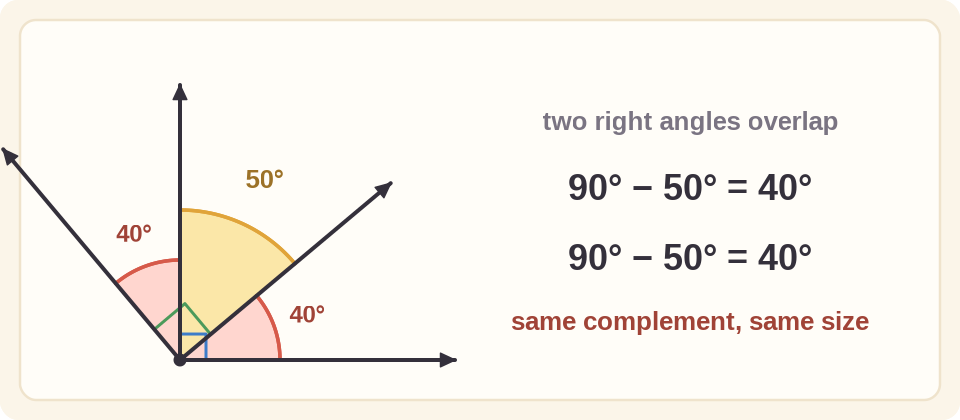
The proof used a fact worth keeping: two angles that are supplements of the same angle are equal. The same goes for complements.
Two right angles overlap, and the middle part belongs to both. Each angle left at the sides is 90° minus that middle part, so the two side angles are equal. With a middle part of 50°, each is 90° − 50° = 40°.
Try it at home
- Draw two crossing lines with a ruler and number the four angles.
- Measure only one angle and work out the other three with reasons.
- Then measure the other three and compare.
Words in this lesson
- vertical angles - two angles across from each other where two straight lines cross; they are equal.
- proof - a reason that shows something is true in every case, not only in the drawings you checked.
Big idea
Vertical angles are equal because each is the supplement of the same angle; angles with the same complement or the same supplement are always equal.