Percent Error
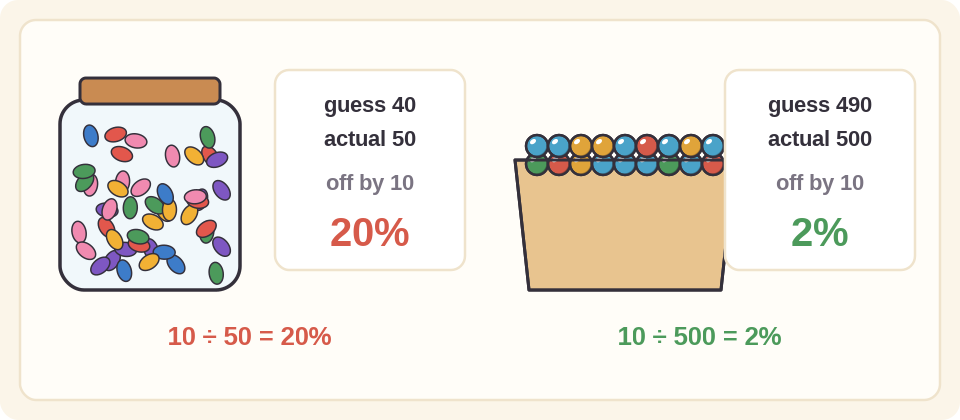
Maya guessed there were 40 jellybeans in a jar. There were 50. Her friend guessed 490 marbles in a box that held 500. Both were off by 10. Who guessed better?
Error out of the actual amount
The error is how far a guess or a measurement is from the actual amount, always counted as a positive number.
The percent error is the error as a percent of the actual amount: percent error = error ÷ actual × 100%.
Maya: 10 ÷ 50 = 0.2 = 20%. Her friend: 10 ÷ 500 = 0.02 = 2%. Her friend's guess was much better, even though both were off by 10.
Measuring errors
Leo measures a board as 1.92 meters. It is really 2 meters. His error is 2 − 1.92 = 0.08 meters, and 0.08 ÷ 2 = 0.04 = 4%.
A guess that is too big counts the same way. Guessing 55 jellybeans for 50 is an error of 5, and 5 ÷ 50 = 10%.
Always divide by the actual
Divide by the actual amount, not the guess. For Maya, 10 ÷ 40 would give 25%, which is wrong: the error is compared with what is really there.
Try it at home
- Guess the length of a table in centimeters, then measure it.
- Find your error and your percent error.
- Guess the length of something else. Did your percent error get smaller?
Words in this lesson
- actual amount - the true amount, found by counting or measuring carefully.
- error - how far a guess is from the actual amount, as a positive number.
- percent error - the error as a percent of the actual amount.
Big idea
Percent error is the error divided by the actual amount: the same error matters less when the actual amount is big.