Multi-Step Number Problems
A worker earns $25 an hour and gets a 10% raise. How much does she earn in a 40-hour week now? Real problems mix fractions, decimals and percents, and they take more than one step.
Four steps
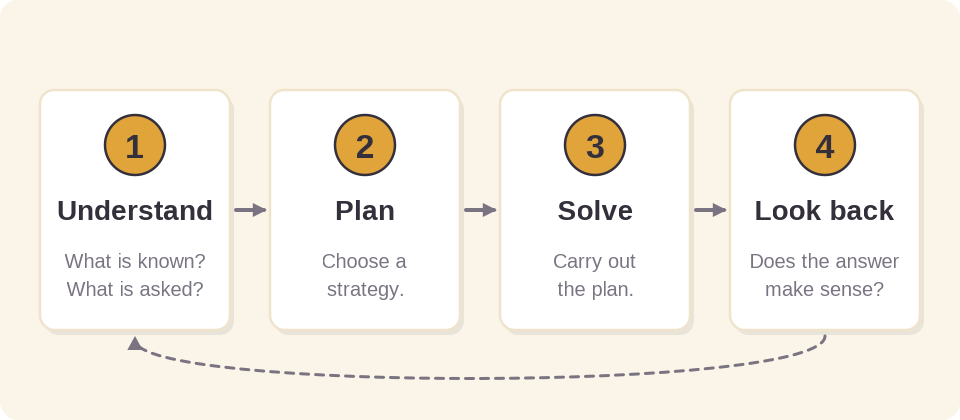
Work in four steps. Understand: what is known, and what is asked? Plan: choose a strategy. Solve: carry out the plan. Look back: does the answer make sense?
For the raise: 10% of $25 is $2.50, so her new rate is $27.50 an hour. In 40 hours that is 40 × 27.50 = $1,100.
Look back: without the raise she would earn 40 × 25 = $1,000, and 10% more is $1,100. The answer checks.
Estimate first
A towel bar inches long goes in the middle of a door inches wide. How far is each end from the edge?
Estimate: about 28 − 10 = 18 inches are left over, so about 9 inches on each side. Exactly: − = , and half of that is inches. The estimate says the exact answer is about right.
A toolbox of strategies
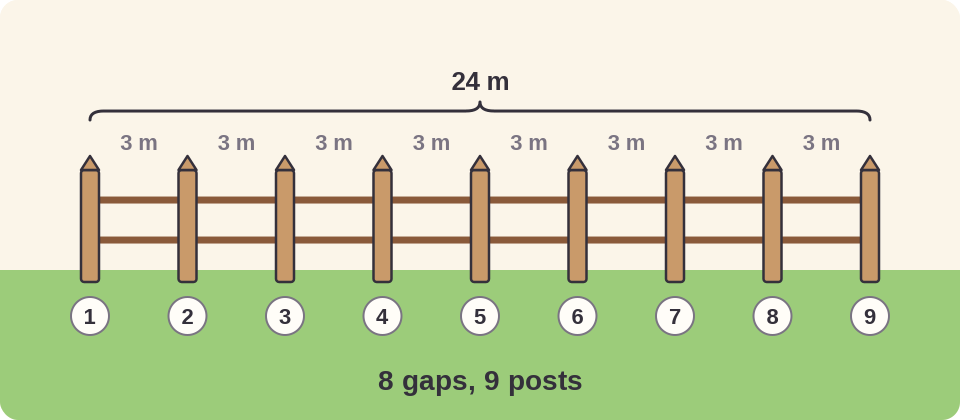
Draw it. A fence 24 meters long has a post every 3 meters, with a post at both ends. 24 ÷ 3 = 8 gaps, but a drawing shows one more post than gaps: 9 posts.
Make a table of guesses. A yard has chickens and rabbits, 10 heads and 28 legs. Guess 5 rabbits: 20 + 10 = 30 legs, too many. Guess 4: 16 + 12 = 28. So 4 rabbits.
Write an equation. A gym charges $20 to join and $15 a month. Sam has paid $110. With n months: , so n = 6.
List every case. How many two-digit numbers can you make from 3, 6 and 8, never using a digit twice? 36, 38, 63, 68, 83, 86: six.
Try it at home
- Find a recipe and make it for 1.5 times as many people.
- Estimate each new amount first, then work it out exactly.
- Look back: does each exact amount agree with its estimate?
Words in this lesson
- estimate - an answer found with rounded numbers, to check that the exact answer is about right.
- strategy - a way to attack a problem: draw it, make a table, write an equation, list every case.
Big idea
Understand, plan, solve and look back; estimate first, so you can tell whether the exact answer makes sense.