Equations with Parentheses
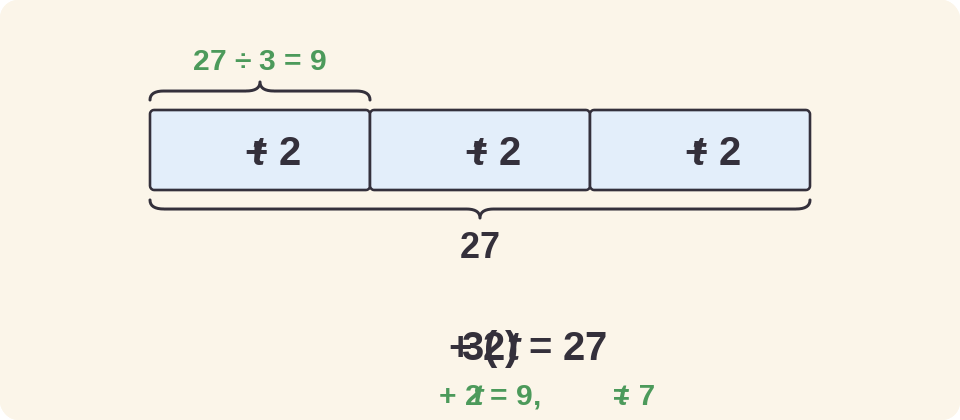
Three friends each buy a movie ticket and a $2 bag of popcorn. They pay $27 in all. Each friend spent t + 2 dollars, so . How do you solve an equation with parentheses?
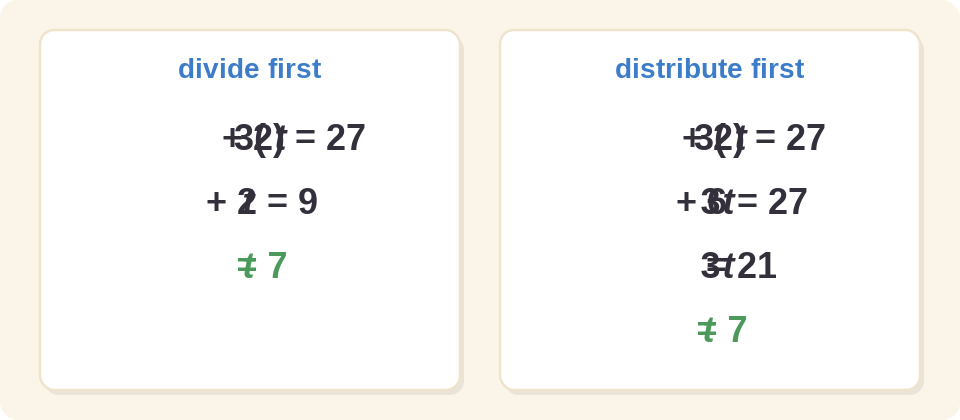
Divide first
means three equal groups of t + 2. If three equal groups make 27, one group is 27 ÷ 3 = 9. So and . A ticket costs $7.
Or distribute first
You can also expand the parentheses: . Now it is a two-step equation: , so . Both ways give the same answer.
Dividing first is quicker when the number outside divides the other side evenly. In , divide by 4: , so .
When it doesn't, distribute. In : , , .
Negatives and fractions
: divide both sides by −2, so and . Check: −2 × (−8 + 5) = −2 × (−3) = 6.
: half of something is 9, so the something is 18. Multiply both sides by 2: , and .
Decimals work the same way. : , so .
Careful
Distributing gives , not : the 3 multiplies both terms.
Try it at home
- Write three equations like 2(x + 3) = 16 on cards.
- Solve each one twice, once dividing first and once distributing first.
- Decide which way was quicker for each, and why.
Words in this lesson
- parentheses - brackets that group terms: 3(t + 2) is 3 groups of t + 2.
- distribute - to multiply the number outside the parentheses by each term inside.
Big idea
To solve p(x + q) = r, divide both sides by p first, or distribute and solve the two-step equation; check the answer either way.