Pattern Rules with n
Maya builds a row of squares with toothpicks, each new square sharing a side with the one before. How many toothpicks does a row of 50 need? A rule with a letter tells, without counting.
From a table to a rule
Figure 1 has 4 toothpicks. Each new square needs only 3 more: it borrows a side.
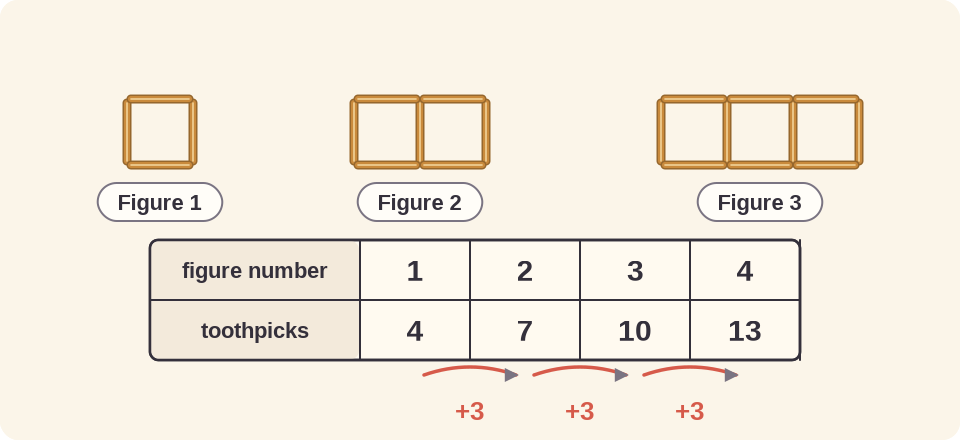
The counts go up by 3 each time, so the rule starts with 3 times the figure number, . Figure 1 gives 3 × 1 = 3, one short, so add 1: . Check: figure 3 has 3 × 3 + 1 = 10.
This rule is the pattern's nth term: put in a figure number for , and out comes the count. In a linear pattern, which grows by the same amount each time, the nth term is the step times , plus what makes the first term right.
So 6, 11, 16, 21, ... (up by 5, and 6 is 5 × 1 + 1) is .
The rule both ways
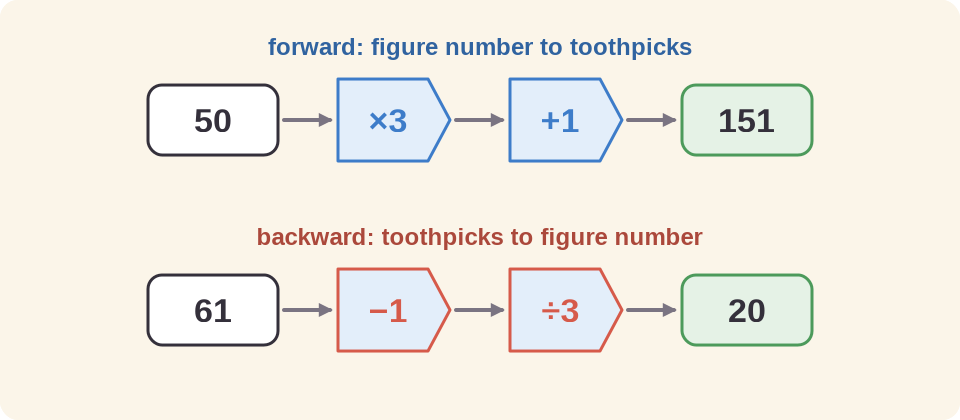
Figure 50 has 3 × 50 + 1 = 151 toothpicks.
Backward: which figure has 61? Undo the rule from the end, take away 1, then divide by 3: 61 − 1 = 60 and 60 ÷ 3 = 20. Figure 20. It is the same as solving .
Can a figure have 90 toothpicks? 90 − 1 = 89, and 89 isn't a multiple of 3. So no figure has 90.
Fractions follow rules too
In , , , ... the bottom is one more than the term number, so the nth term is , and the 9th term is .
Careful
Don't put 61 in for : 3 × 61 + 1 = 184 is figure 61's count.
Try it at home
- Build toothpick squares in a row up to figure 5.
- Make a table and find the nth term.
- Predict figure 20, then build it and count.
Words in this lesson
- term - one number in a pattern.
- nth term - a rule with the letter n that gives any term from its term number.
- linear pattern - a pattern that grows or shrinks by the same amount each time.
Big idea
The nth term of a linear pattern is the step times n plus a fix for the first term; use it forward for any term and backward to find a term number.