Decimals That End or Repeat
Turn into a decimal and you get 0.375, which stops. Turn into one and the 6s never stop. Long division shows which fractions do which, and why.
Long division that ends
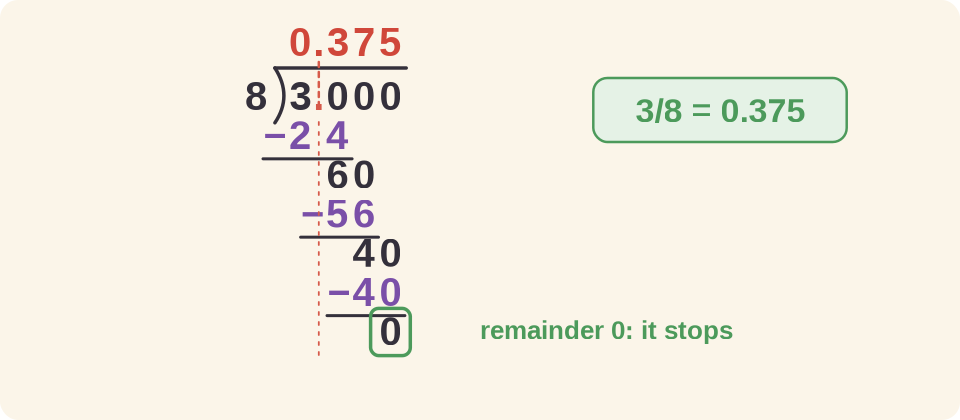
A fraction is its top divided by its bottom, so = 3 ÷ 8. Write 3 as 3.000 and divide.
8 goes into 30 three times, remainder 6; into 60 seven times, remainder 4; into 40 five times, remainder 0. The remainder is 0, so the division stops: 0.375 is a terminating decimal.
Long division that repeats
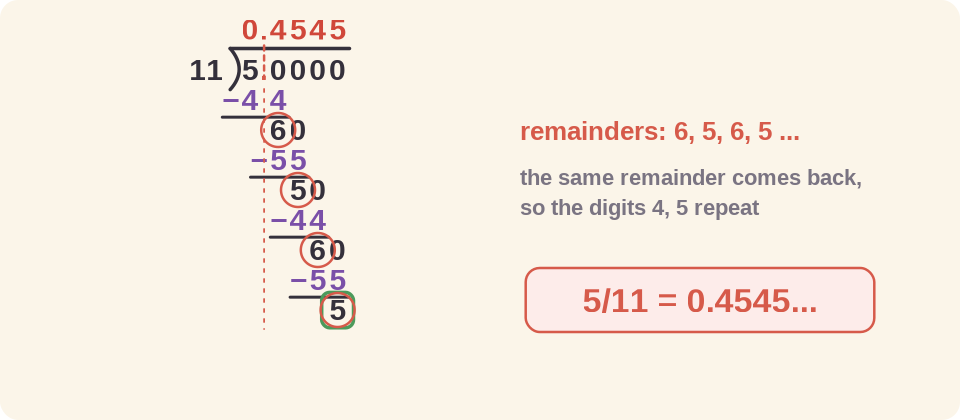
Now = 5 ÷ 11. 11 into 50 goes 4 times, remainder 6. 11 into 60 goes 5 times, remainder 5. That is where we started, so the digits 4, 5 come again and again: 0.454545...
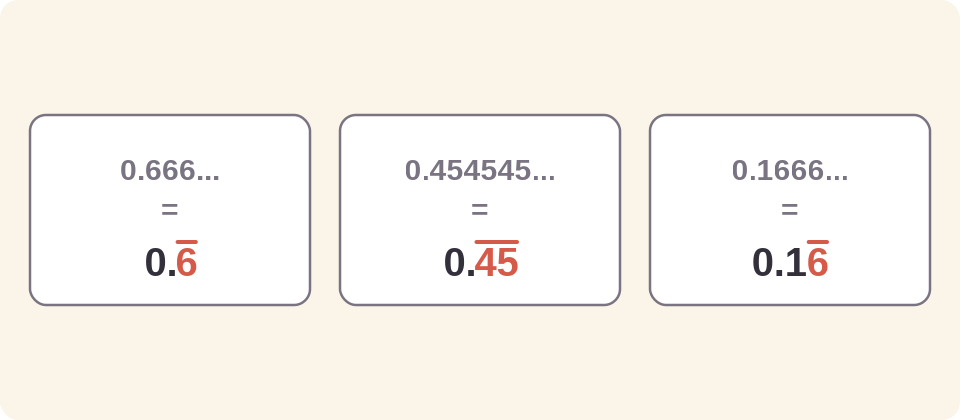
A decimal like this is a repeating decimal. Write it with a bar over the digits that repeat: . And = , = 0.1666... = .
Why it must end or repeat
Dividing by 11, the only possible remainders are 0 to 10. If 0 comes, the decimal ends. If not, a remainder must come back sooner or later, and from then on the digits repeat.
A fraction in simplest form ends when its bottom has no prime factors but 2 and 5: = 0.35. Any other prime, like 3 in , makes it repeat: . Negative fractions work the same way: − = −0.625.
Careful
The bar goes only over the digits that repeat: 0.1666... has the bar over the 6, not over 16.
Try it at home
- Pick five fractions with bottoms from 2 to 12.
- Turn each into a decimal by long division, stopping when it ends or a remainder comes back.
- Write the repeating ones with a bar, then check them on a calculator.
Words in this lesson
- terminating decimal - a decimal that ends, like 0.375.
- repeating decimal - a decimal whose digits repeat forever, written with a bar: 0.454545... = 0.45 with a bar over 45.
Big idea
Long division turns a fraction into a decimal that either ends (a remainder of 0) or repeats (a remainder comes back), written with a bar.