Adjacent Angles
Open a paper fan or a pair of scissors and you see angles side by side. When two angles sit next to each other, their sizes add up, and that one fact solves many angle puzzles.
Naming an angle
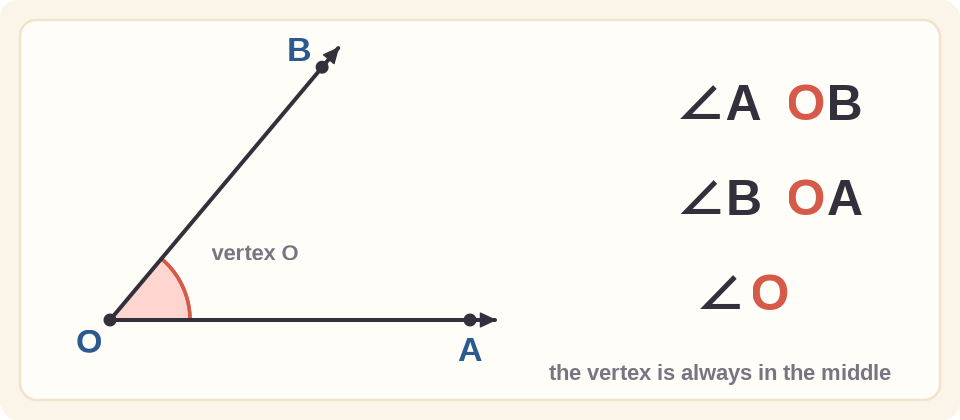
An angle has a vertex, the point where it starts, and two sides that are rays. We name it with three letters, the vertex always in the middle: ∠AOB, or ∠BOA, which is the same angle. When only one angle sits at a vertex, its letter alone is enough: ∠O.
Some books put a small hat over the vertex letter instead of the ∠ sign, and write AÔB. It means the same thing: the middle letter is the vertex.
Side by side
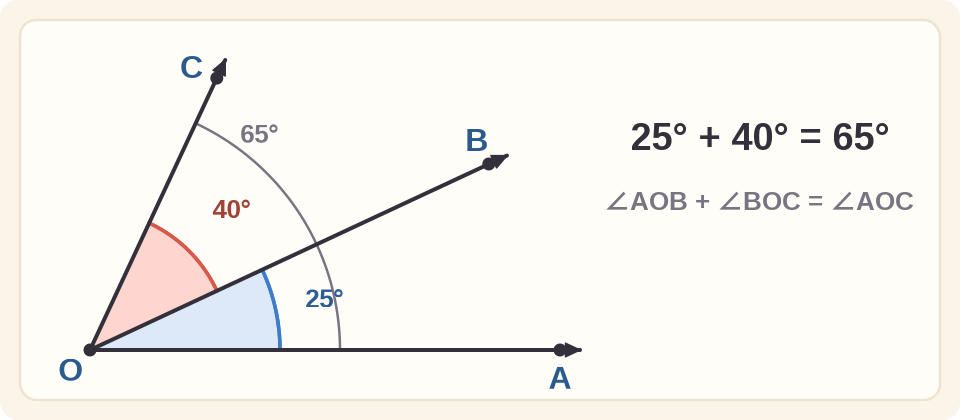
Two angles are adjacent when they share a vertex and a side and don't overlap. In the picture, ∠AOB and ∠BOC share the side OB.
Together they make the bigger angle ∠AOC, so their sizes add: ∠AOB + ∠BOC = ∠AOC. If ∠AOB = 25° and ∠BOC = 40°, then ∠AOC = 65°.
It works backwards too. If ∠AOC = 75° and ∠AOB = 30°, then ∠BOC = 75° − 30° = 45°.
On a line and around a point
Adjacent angles that fill a straight line add up to 180°. Angles that go all the way around a point add up to 360°.
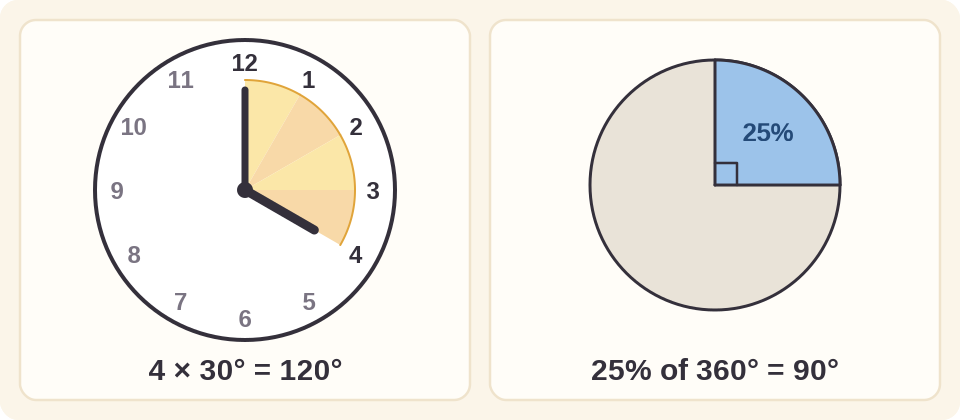
A clock face is 360° cut into 12 equal angles, one from each number to the next, so each is 360° ÷ 12 = 30°. At 4 o'clock the hands are 4 numbers apart: 4 × 30° = 120°.
A pie chart works the same way. A slice that is 25% of the circle has an angle of 25% of 360°, which is 90°.
Try it at home
- Draw an angle, then a ray inside it from the vertex.
- Measure the two small angles and the big one with a protractor.
- Do the two small ones add up to the big one? Give each angle its three-letter name.
Words in this lesson
- vertex - the point where the two sides of an angle start.
- adjacent angles - two angles that share a vertex and a side and don't overlap.
Big idea
Adjacent angles share a vertex and a side, so their sizes add; on a straight line they make 180° and around a point 360°.