Circle Problems
Fencing a round garden and covering it with grass are different jobs. One needs the distance around, the other the area. Most circle problems start with that choice.
Around or inside?
A fence, a frame, a ribbon or the distance a wheel rolls goes around: use the circumference. Grass, paint, a tablecloth or a pizza covers the inside: use the area, in square units.
A round table is 1.2 m across. A ribbon around its edge is 3.14 × 1.2 = 3.768 m long. A cloth that just covers its top needs the radius, 0.6 m: 3.14 × 0.6 × 0.6 = 1.1304 m², a little more than 1 m².
Half circles
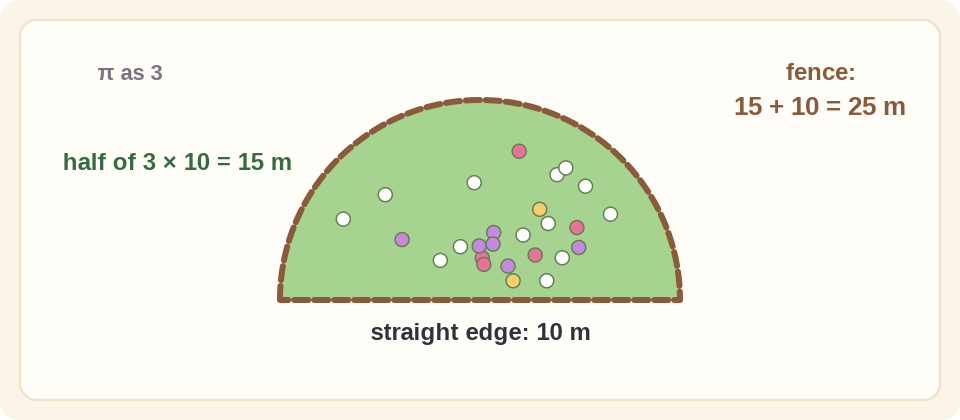
A flower bed is a half circle 10 m across. A fence all the way round it needs half the circumference plus the straight edge. With π as 3: 3 × 10 ÷ 2 + 10 = 15 + 10 = 25 m.
Its area is half a circle with a radius of 5 m: 3 × 5 × 5 ÷ 2 = 37.5 m².
Taking a circle away
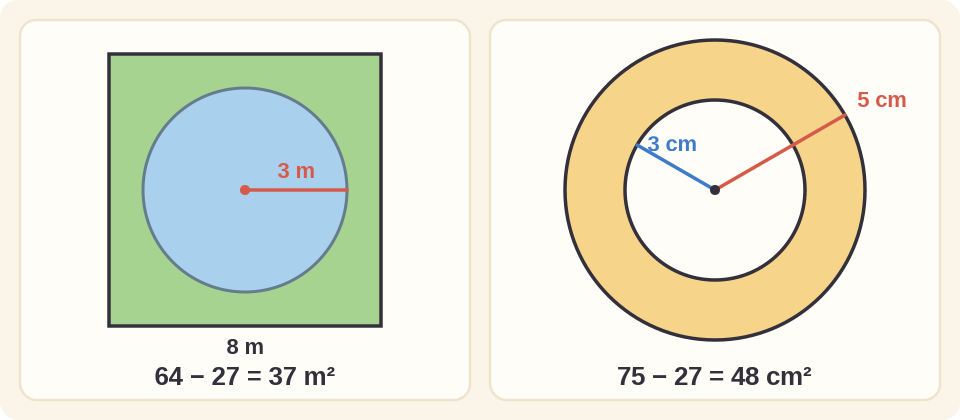
A square garden 8 m on a side has a round pond with a radius of 3 m in the middle. The grass is the square minus the circle. With π as 3: 8 × 8 − 3 × 3 × 3 = 64 − 27 = 37 m².
A ring, like a washer or a round running track, is a big circle minus a small one. Radii of 5 cm and 3 cm, with π as 3: 3 × 5 × 5 − 3 × 3 × 3 = 75 − 27 = 48 cm².
Try it at home
- Find a round thing at home: a table, a rug or a clock.
- Measure across it and work out the length of ribbon to go around it and the area of cloth to cover it.
- Which of your answers is in square units?
Words in this lesson
- half circle - half of a circle, cut along a diameter; its edge is half the circumference plus the diameter.
- ring - the part between two circles with the same center.
Big idea
Decide whether a problem goes around (circumference) or covers (area), and build odd shapes from circles, halves and squares by adding or taking away.