Solving for Unknown Angles
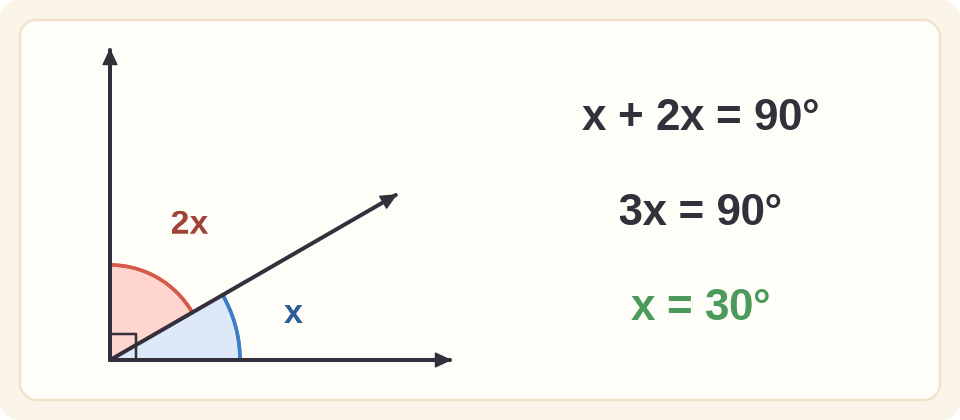
A right angle is cut into two pieces, and one piece is twice the other. How big is each? Guessing is slow; an equation gets it right away.
x and 2x
Call the small piece . The big piece is twice as big, . Together they make a right angle: .
Combine like terms: . Divide both sides by 3: . So the pieces are 30° and 60°. Check: 30° + 60° = 90°.
On a straight line
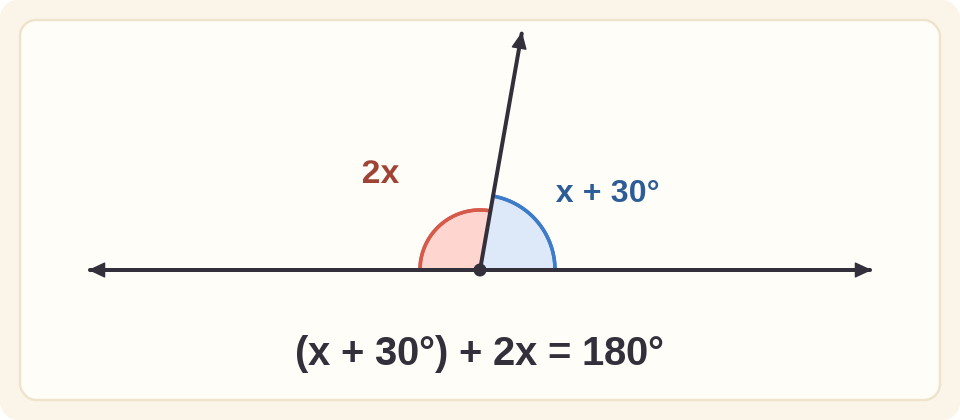
Two adjacent angles on a straight line are and . They are supplementary, so .
That is . Subtract 30° from both sides: . Divide by 3: .
The question asked for the angles, not for x, so put 50 back in: the angles are 80° and 100°, and 80° + 100° = 180°.
Across a crossing and around a point
Vertical angles are equal. If two of them are and 70°, then , so and .
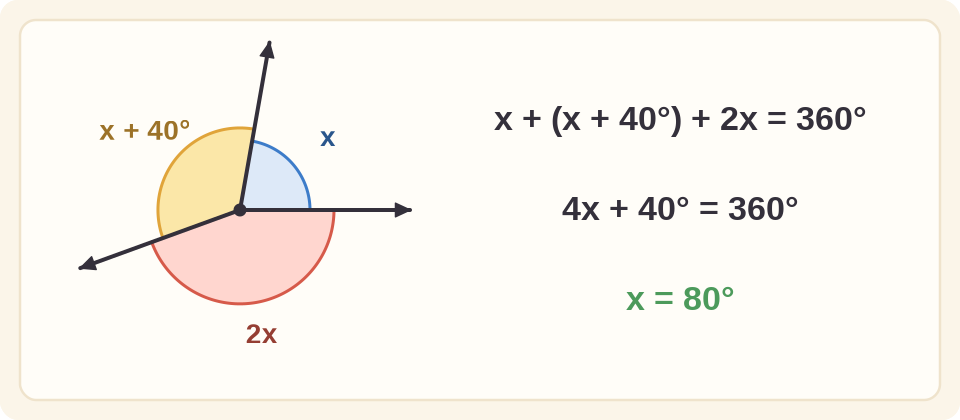
Three angles around a point are , and . All the way around makes 360°: , so and . The angles are 80°, 120° and 160°.
Try it at home
- Draw a straight line and a ray rising from it.
- Ask someone to tell you only that one angle is 20° more than the other.
- Write an equation, solve it, and measure to check.
Words in this lesson
- unknown angle - an angle whose size you don't know yet, named with a letter.
Big idea
Write what you know about the angles as an equation (they add up to 90°, 180° or 360°, or they are equal), solve it, and check by putting the answer back.