Relative Frequency
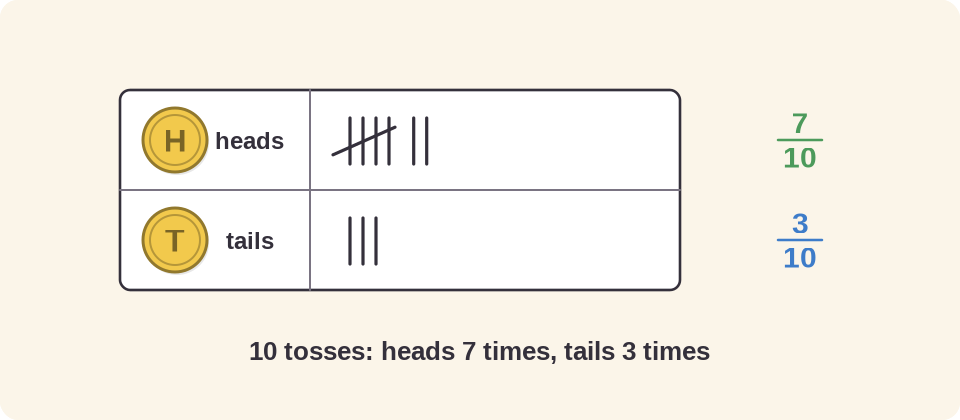
Leo tossed a coin 10 times and got heads 7 times. Does that make the probability of heads 7 out of 10? Or was it just luck?
What happened, as a fraction
The relative frequency of an event is the number of times it happened divided by the number of tries. Leo's relative frequency of heads is , or 0.7.
The probability of heads is still . In a few tries, the relative frequency can be far from the probability. 7 heads in 10 tosses is not strange at all.
Many tries get close
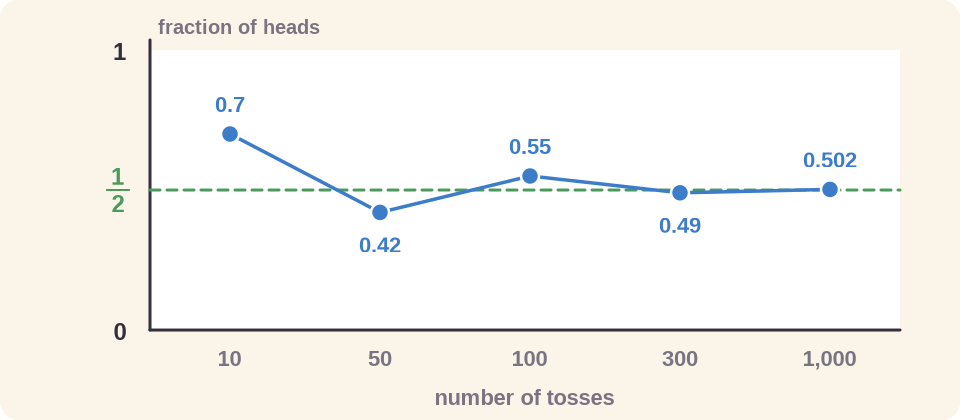
Leo keeps going, and the whole class adds their tosses to his. After 50 tosses heads has come 21 times, 0.42. After 100 tosses, 55 times, 0.55. After 1,000 tosses, 502 times, 0.502.
The more tries, the closer the relative frequency gets to . That is why a class pools its tries: many tries tell you more than a few.
So in 20 tosses, expect heads about 10 times, but 8 or 12 is quite normal. A probability does not say exactly what will happen in a few tries.
A coin has no memory
Mia got tails 5 times in a row. Is heads now due? No. The coin does not remember what came before. The next toss has the same two equally likely outcomes, so tails is still .
The same goes for a die, a spinner, or a bead that is put back in the bag and mixed in after every draw.
Careful
A run of tails does not make heads more likely. Each toss starts fresh.
Try it at home
- Toss a coin 10 times and write the relative frequency of heads.
- Toss it 40 more times and write it again for all 50.
- Which is closer to 1/2? Pool your tosses with a friend's and check again.
Words in this lesson
- relative frequency - the number of times an event happened divided by the number of tries.
- experiment - something you do again and again whose outcome is left to chance, like tossing a coin.
Big idea
The relative frequency can be far from the probability in a few tries but gets close to it in many, and past tries never change the next one.