Predicting with Probability
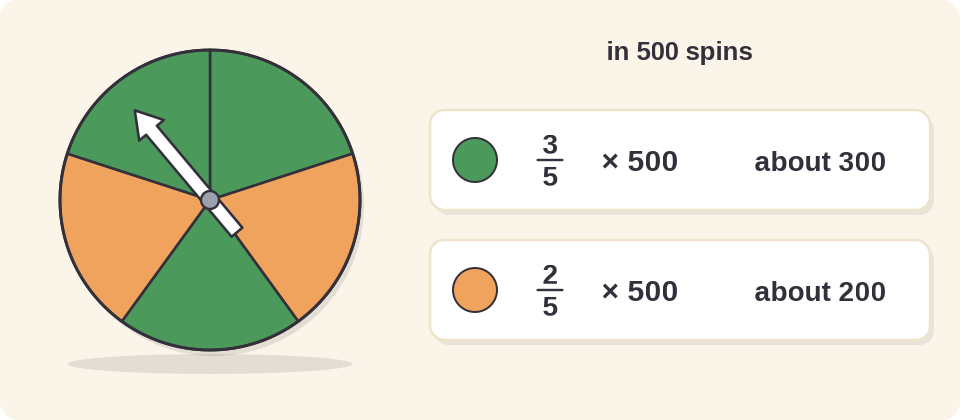
A spinner has 5 equal parts: 3 green and 2 orange. You will spin it 500 times. Can you say, before you start, about how many times it will stop on green?
Probability times the number of tries
The probability of green is . So in many spins, about of them should be green. of 500 is 500 ÷ 5 × 3 = 300.
This is the expected count: the probability times the number of tries. Expect green about 300 times.
About, not exactly
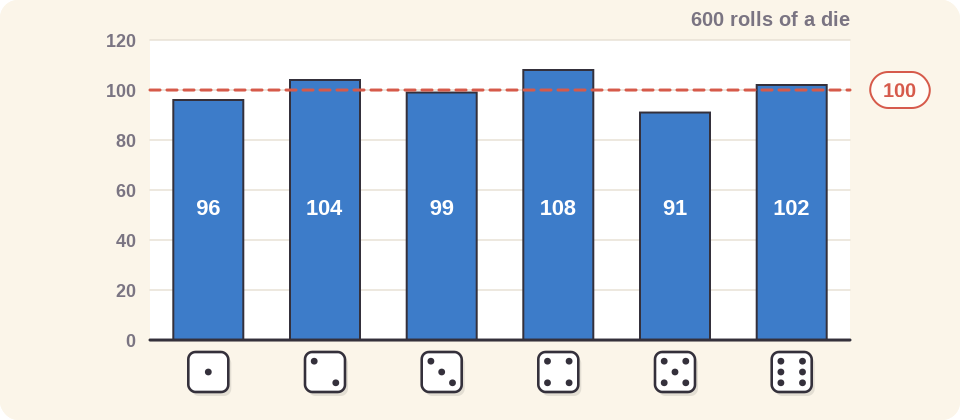
A die is rolled 600 times. The probability of a 6 is , and of 600 is 100. So expect about 100 sixes.
In a real try, the counts came out 96, 104, 99, 108, 91 and 102. Each is near 100, none is exactly 100. That is just what to expect: the expected count is a good guess, not a promise.
Predicting from data
When there is no model to count, use a relative frequency instead. A basketball player made 72 of her last 90 free throws, a relative frequency of 0.8.
In her next 40 free throws, predict about 0.8 × 40 = 32 baskets. Like any prediction from chance, the real number will be close, not certain.
Try it at home
- Roll a die 60 times and tally each face.
- How many times did you expect each face? Write 1/6 × 60.
- How far from that was each real count?
Words in this lesson
- expected count - the probability of an event times the number of tries: about how often it should happen.
- prediction - a careful guess about what will happen, made from a probability.
Big idea
Expect an event about (probability × number of tries) times; the real count will be near that number, not exactly it.