Surface Area of Prisms
How much paper wraps a triangular chocolate bar? Add up its faces, with a shortcut for the sides.
Roll it along the paper
The lateral faces of a prism are its sides, the rectangles between the two bases. Together they make its lateral area.
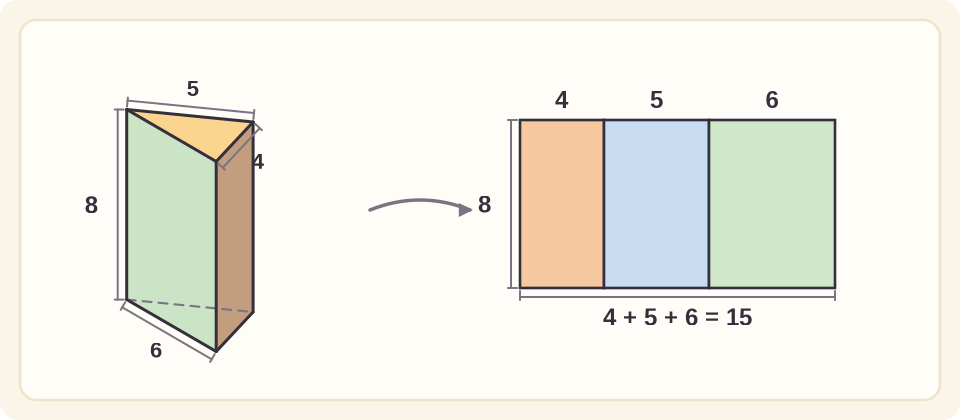
Roll a prism along a sheet one side at a time, and its sides print one long rectangle. It is as tall as the prism and as long as the base's perimeter.
So the lateral area is the base's perimeter times the height. A triangular prism with sides of 4, 5 and 6 cm and a height of 8 cm has a lateral area of (4 + 5 + 6) × 8 = 15 × 8 = 120 cm².
Add the two bases
The surface area, or total area, is the lateral area plus the two bases.
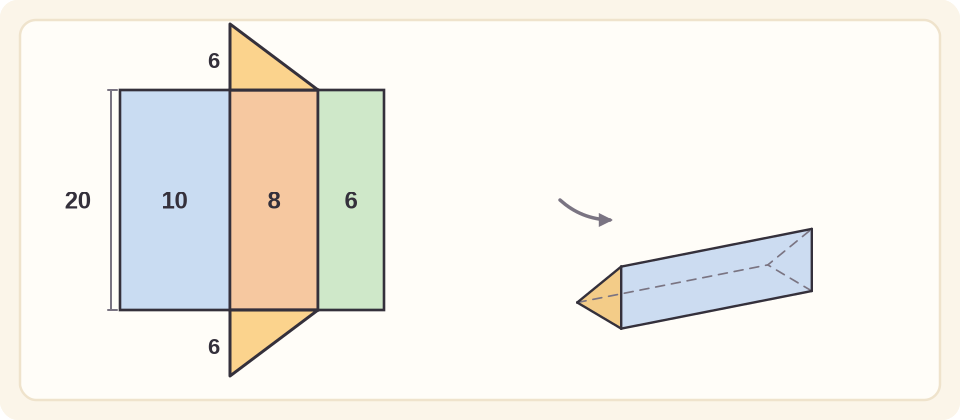
A prism whose base is a right triangle with sides of 6, 8 and 10 cm, 20 cm long: lateral area (6 + 8 + 10) × 20 = 480 cm². Each base is 6 × 8 ÷ 2 = 24 cm², and two make 48. Surface area: 480 + 48 = 528 cm².
For a box, this gives the same answer as adding its three pairs of faces.
The net of a cylinder
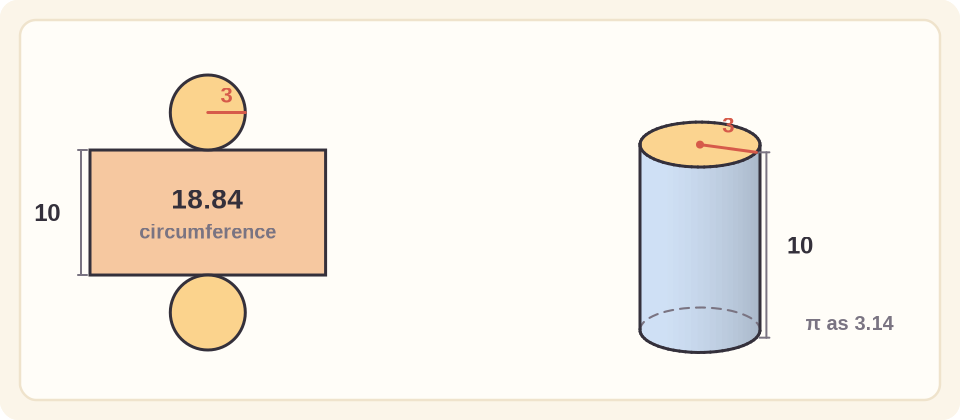
A can's label laid flat is a rectangle. Its height is the can's height, and its length wraps once around the circle, so it is the circumference, 2 × π × r.
A can with a radius of 3 cm and a height of 10 cm, with π as 3.14: the label is 2 × 3.14 × 3 = 18.84 cm long, so it covers 18.84 × 10 = 188.4 cm². The two circles add 2 × 3.14 × 3 × 3 = 56.52 cm². In all, 244.92 cm².
Try it at home
- Find a box of tea or crackers and measure the perimeter of its bottom and its height.
- Work out its lateral area, then add the top and the bottom.
- Unfold the box to check.
Words in this lesson
- lateral area - the area of a solid's sides, without its bases.
- surface area - the area of all the faces of a solid together, its bases included.
- circumference - the distance around a circle, 2 × π × r.
Big idea
A prism's lateral area is its base's perimeter times its height; its surface area adds the two bases.