Scale Drawings
Nobody can draw a backyard full size on paper. A plan draws it small, every length shrunk by the same amount.
Same shape, smaller size
In a scale drawing, every real length is multiplied by the same number. The shape and every angle stay the same; only the size changes.
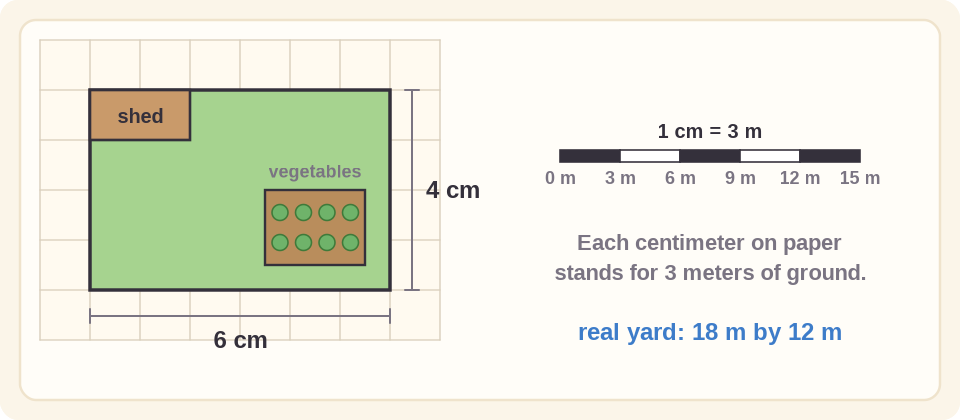
The scale says how a length on the drawing matches a real length. On this plan the scale is 1 cm to 3 m: each centimeter on paper stands for 3 meters of real ground.
From the drawing to the real thing and back
To find a real length, multiply the length on the plan by what 1 cm stands for. The yard is 6 cm long on the plan, so it is really 6 × 3 = 18 m long. Its 4 cm width is 4 × 3 = 12 m.
To go back, divide: a real fence 9 m long is drawn 9 ÷ 3 = 3 cm.
A scale is a ratio, so a plan and the real yard are proportional.
A scale as a ratio
A scale can also be written with no units at all, as a ratio like 1 : 100. Then 1 of anything on the drawing is 100 of the same thing in real life: 1 cm stands for 100 cm, which is 1 m.
A classroom 8 cm long on a 1 : 100 plan is 800 cm long, which is 8 m.
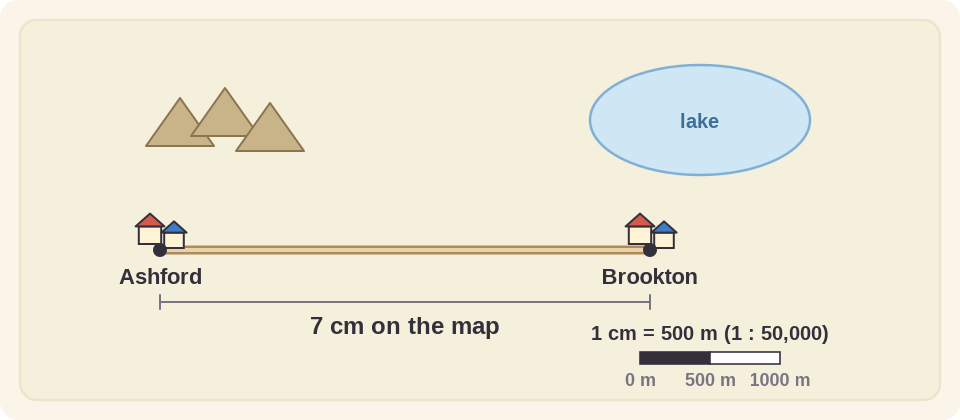
Maps shrink more. At 1 : 50,000, 1 cm stands for 50,000 cm, which is 500 m. Two towns 7 cm apart on the map are 7 × 500 = 3,500 m apart, or 3.5 km.
Careful
Put both sides in the same unit before writing a scale as a ratio: 1 cm to 2 m is 1 cm to 200 cm, so it is 1 : 200, not 1 : 2.
Try it at home
- Measure your bedroom in meters.
- Draw it on squared paper with 1 square for half a meter.
- Add your bed at the same scale.
Words in this lesson
- scale drawing - a drawing of a real thing where every length is multiplied by the same number.
- scale - how a length on a drawing matches a real length, like 1 cm to 3 m or 1 : 100.
Big idea
In a scale drawing every length is the real length times the same number; the scale tells you that number.