Populations and Samples
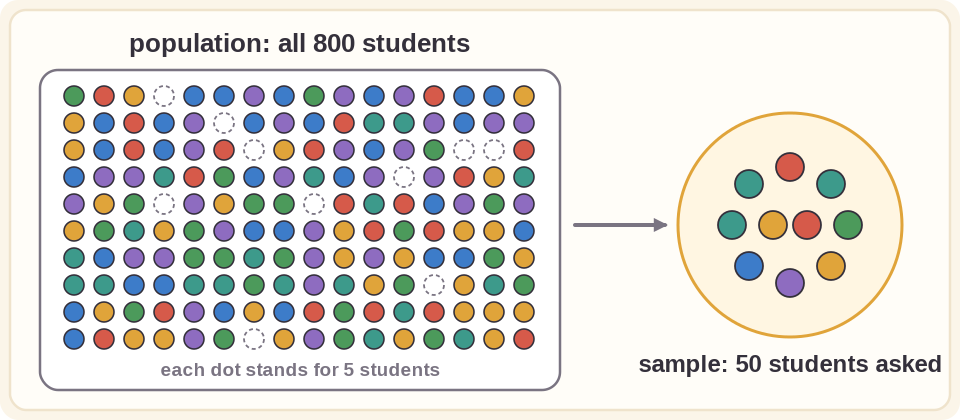
Your school has 800 students, and the cafeteria wants to know which lunch they like best. Asking all 800 would take days. Is there a quicker way to find out?
The whole group and a part
The population is the whole group you want to learn about. Here it is all 800 students of the school.
A sample is the part of the population you actually ask, count or measure. The cafeteria might ask 50 students and use their answers to learn about all 800.
Asking every member of the population is called a census. Every ten years, the United States and Canada each try to count every person in the country, and it is a huge job.
Why take a sample?
Often a census is impossible or silly. Nobody can catch every fish in a lake to measure it. A factory that tests how long its batteries last cannot test them all, or there would be none left to sell.
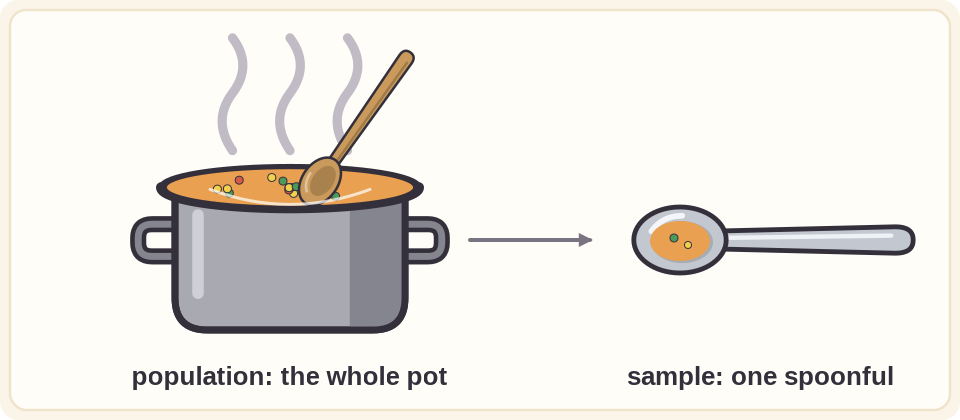
Think of a cook tasting soup. She does not drink the whole pot: one spoonful tells her if it needs salt. But she stirs first. A spoonful from the top of a pot that was not stirred might taste nothing like the rest.
Naming them in a question
A biologist catches 40 trout in a lake and measures them. The population is all the trout in the lake. The sample is the 40 she caught.
A sample is only useful if it looks like the population, the way the stirred spoonful tastes like the whole pot. A sample like that is called representative.
Try it at home
- Pour a bag of mixed nuts or candies into a bowl and stir them.
- Without looking, take out a small handful. That is your sample.
- Count each kind in your handful, then count each kind in the whole bowl. Does the handful look like the bowl?
Words in this lesson
- population - the whole group you want to learn about.
- sample - the part of the population you actually ask or measure.
- census - asking or counting every member of a population.
- representative - a sample that looks like its population.
Big idea
A sample is a part of a population that you study to learn about the whole, so it must look like the whole.