Dividing Signed Numbers
Three friends owe 12 dollars together and split the debt equally. Each one owes 4 dollars: (−12) ÷ 3 = −4. Division has the same sign rules as multiplication.
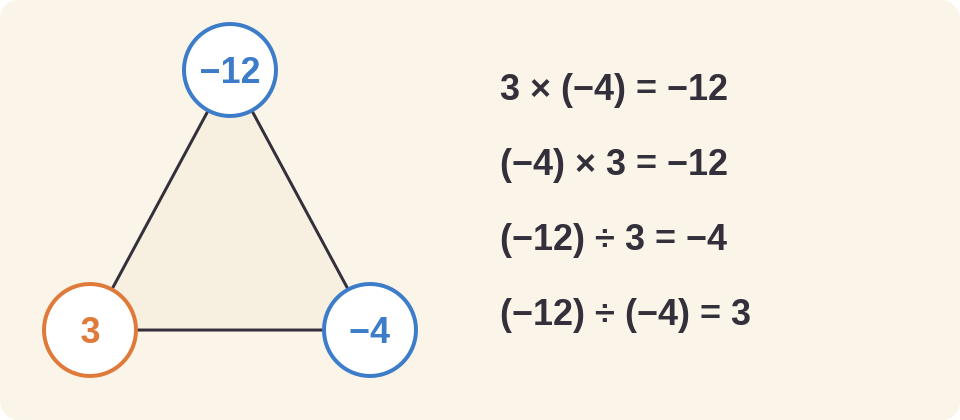
Use the related multiplication
A division asks which number times the divisor gives the dividend. (−12) ÷ 3 asks: 3 × ? = −12. The answer is −4.
(−12) ÷ (−4) asks: (−4) × ? = −12. The answer is 3. And 12 ÷ (−4) = −3, because (−4) × (−3) = 12.
So the sign rules are the same: same signs give a positive quotient, different signs a negative one. Dividing by 0 has no answer, since nothing times 0 makes 12.
Sharing counters
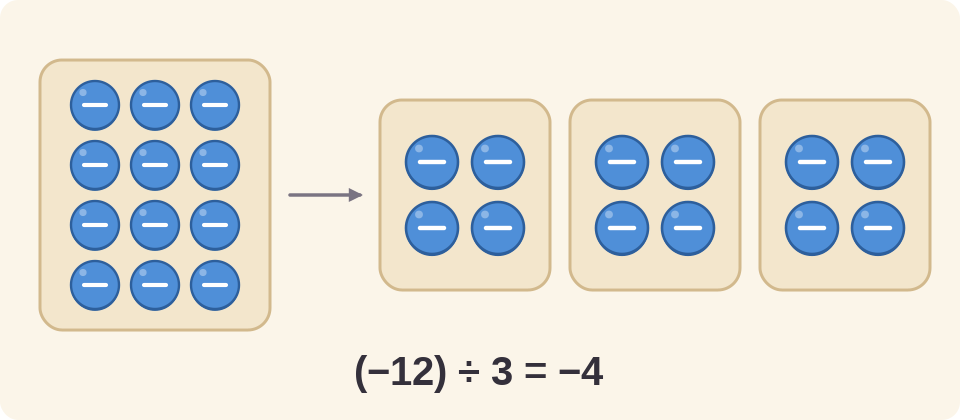
Share 12 blue counters equally among 3 trays: each tray gets 4 blue counters, so (−12) ÷ 3 = −4.
Several operations
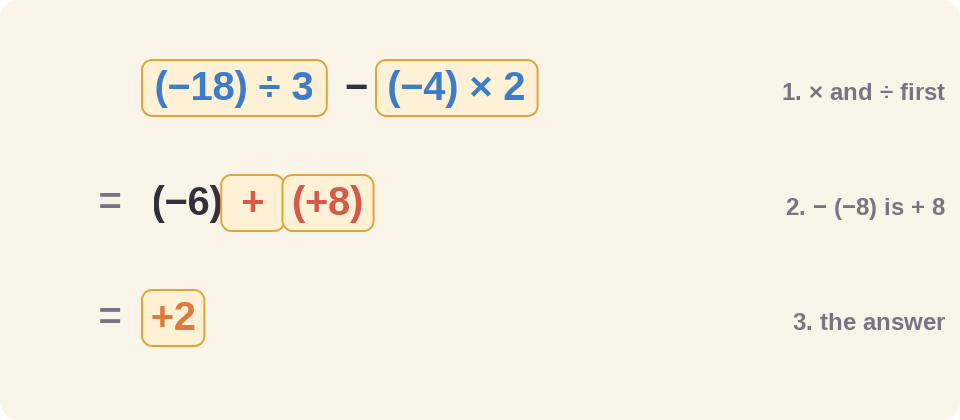
With several operations, work inside parentheses first, then × and ÷ from left to right, then + and −. (−3) × 4 + 10 = −12 + 10 = −2.
((−8) + 2) ÷ (−3) = (−6) ÷ (−3) = 2. And (−18) ÷ 3 − (−4) × 2 = (−6) − (−8) = (−6) + 8 = 2.
Try it at home
- Write four facts of one family, like 5 × (−6) = −30.
- Cover one number in each and ask someone to find it.
- Make up a debt-sharing story for one of the divisions.
Words in this lesson
- quotient - the result of a division.
- divisor - the number you divide by; it can never be 0.
Big idea
Divide signed numbers like whole numbers and give the quotient a sign by the same rule as multiplying: same signs positive, different signs negative.