Equation Word Problems
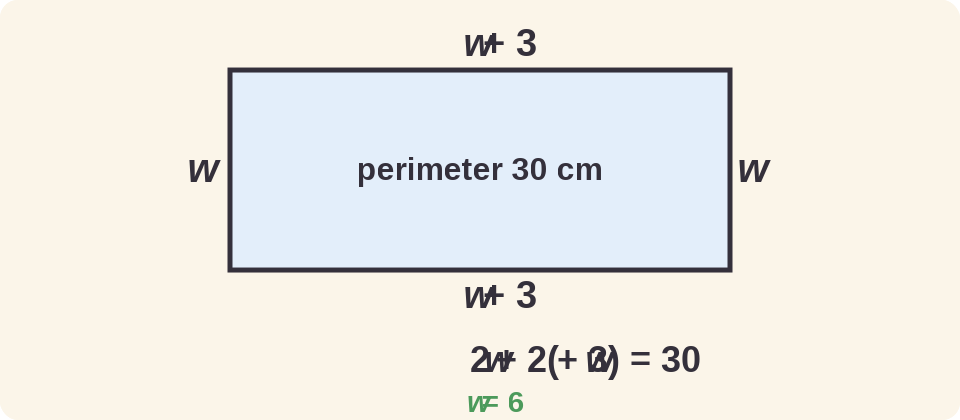
A rectangle is 3 cm longer than it is wide, and its perimeter is 30 cm. How wide is it? Many problems are quickest with an equation, if you follow four steps.
Choose, write, solve, check
Choose a letter for the unknown and say what it stands for: let w be the width in cm. Then the length is .
Write the equation from the story: two widths and two lengths make 30, so .
Solve: , , , . Check in the story, not just the equation: 6 by 9 has perimeter 6 + 9 + 6 + 9 = 30.
Numbers in a row
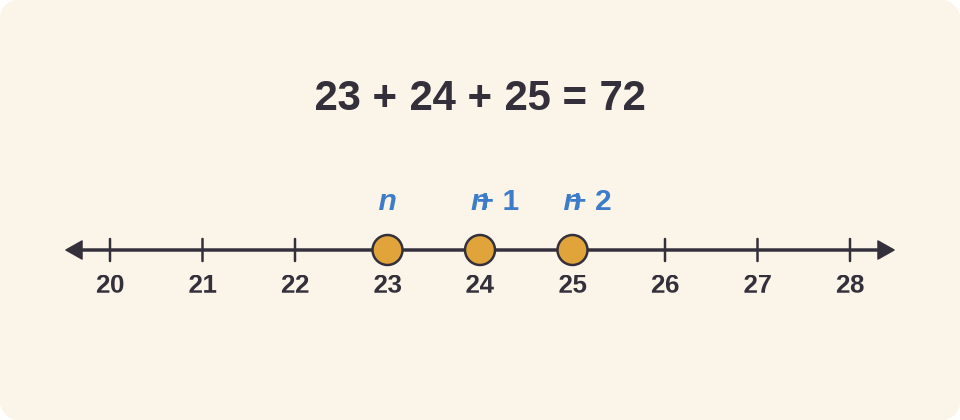
Three whole numbers in a row add up to 72. Let n be the smallest. The next two are and .
, so , , and . The numbers are 23, 24 and 25. Check: 23 + 24 + 25 = 72.
Two plans
Phone plan A costs $20 a month plus $5 for each gigabyte. Plan B costs $35 plus $2 for each gigabyte. For how many gigabytes do they cost the same?
With g gigabytes: . Take from both sides: , so and . Check: 20 + 25 = 45 and 35 + 10 = 45.
Try it at home
- Ask someone at home their age and the age of a younger relative.
- Make up a puzzle: the two ages add up to some number, and one is so many years more than the other.
- Write the equation with one letter, solve it, and check that the ages are right.
Words in this lesson
- variable - a letter that stands for the unknown number in a problem; say what it means before you use it.
- check - putting the answer back into the story to see that every fact holds.
Big idea
Choose a letter for the unknown, write the equation from the story, solve it, and check the answer in the story.