Scale and Area
A poster is enlarged so that every length is twice as long. Does it need twice as much paper? Try it with squares, and you will find it needs four times as much.
Double the sides
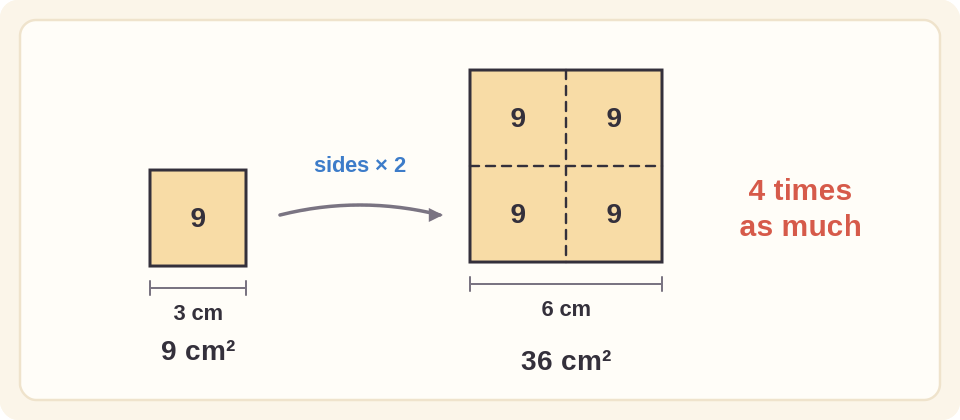
A square 3 cm on a side has an area of 3 × 3 = 9 cm². Double its sides to 6 cm, and the area is 6 × 6 = 36 cm².
36 is 4 times 9, not 2 times. The length doubles and the width doubles too, so 2 rows of 2 small squares fit inside the big one: 2 × 2 = 4.
The scale factor times itself
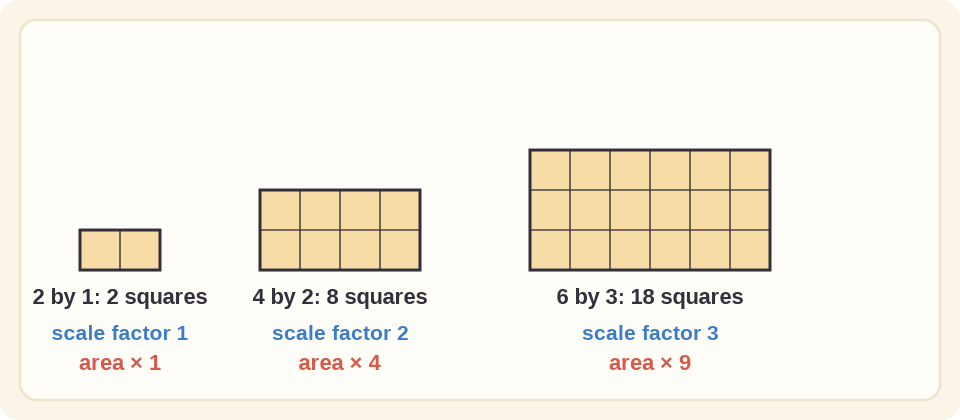
Triple every length, and the area is 3 × 3 = 9 times as big. Halve every length, and the area is × = as big.
So when every length is multiplied by a scale factor, the area is multiplied by the scale factor times itself, the scale factor squared.
Real area from a plan
A garden plan has a scale of 1 cm to 2 m. A flower bed on it is 3 cm by 2 cm, so it covers 6 cm² of paper.
The real bed is 3 × 2 = 6 m long and 2 × 2 = 4 m wide, so it covers 6 × 4 = 24 m².
Look at what happened: each square centimeter of plan, 1 cm by 1 cm, stands for a square 2 m by 2 m, which is 4 m². Six of them make 6 × 4 = 24 m². Multiplying the 6 cm² by 2 alone would give 12, which is wrong.
Careful
A scale for lengths is not a scale for areas: 1 cm to 2 m means 1 cm² to 4 m².
Try it at home
- Cut out a square of paper 2 cm on a side and draw a square 4 cm on a side.
- How many small squares cover the big one?
- Guess, then check, how many would cover a square 6 cm on a side.
Words in this lesson
- scale factor - the number every length is multiplied by.
- square of a number - the number times itself, like 3 × 3 = 9.
Big idea
When every length is multiplied by a scale factor, the area is multiplied by that scale factor times itself.