Sample Spaces
Ava tosses a coin and rolls a die at the same time. She wins if she gets heads and a 6. What is the probability that she wins? First, find every way the two can come out together.
Every outcome, in order
The sample space is the list of every possible outcome of an experiment. An event made of two or more parts, like a coin and a die, is a compound event.
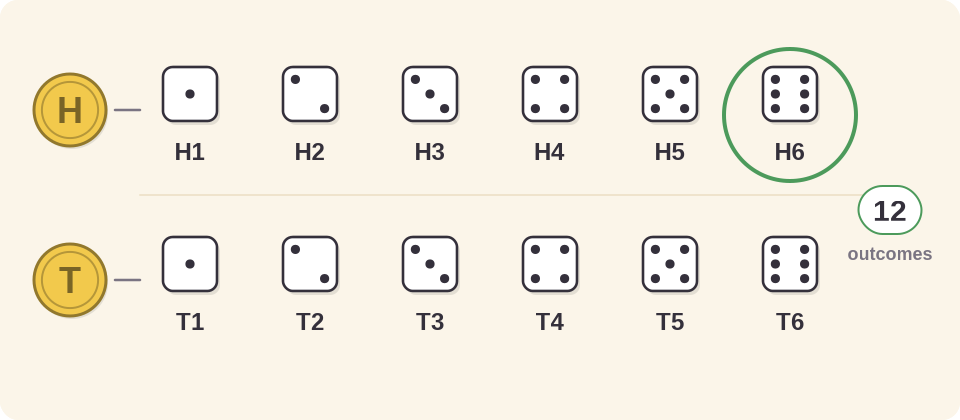
To list a sample space without missing any outcome, keep one part fixed and run through the other. Heads with 1, 2, 3, 4, 5, 6. Then tails with 1, 2, 3, 4, 5, 6.
That is an organized list. It has 2 × 6 = 12 outcomes, all equally likely.
Count the favorable ones
Only one of the 12 outcomes is heads and a 6. So Ava wins with probability .
Heads with an even number is H2, H4 and H6: = .
Two coins: a famous trap
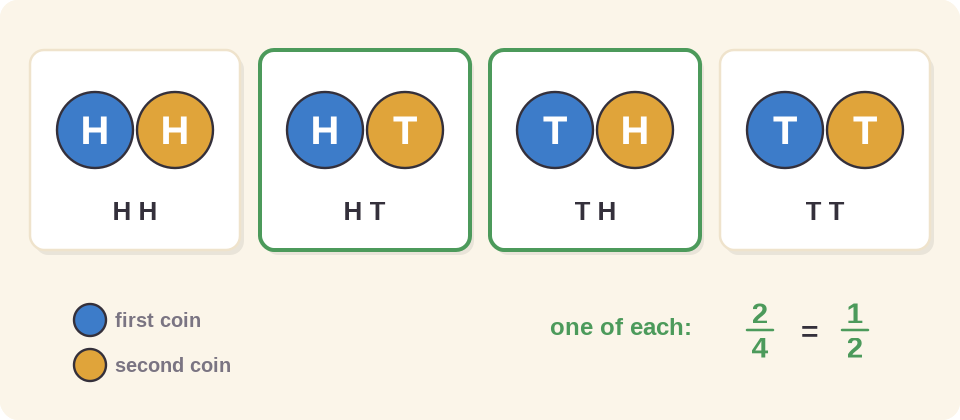
Two coins are tossed. What is the probability of one head and one tail? You might say there are three results, two heads, two tails or one of each, so the answer is 1 out of 3.
But those three are not equally likely. List the outcomes coin by coin: HH, HT, TH, TT. One of each comes in two ways, HT and TH. So the probability is = .
Try it at home
- Toss two coins 40 times and tally: two heads, two tails, one of each.
- Which came most often?
- Does it match 1/4, 1/4 and 1/2?
Words in this lesson
- sample space - the list of every possible outcome of an experiment.
- compound event - an event made of two or more parts, like a coin and a die.
- organized list - a list made in an order, so no outcome is missed or written twice.
Big idea
List the sample space in order, then the probability of a compound event is favorable outcomes ÷ all the outcomes.