Making Inferences
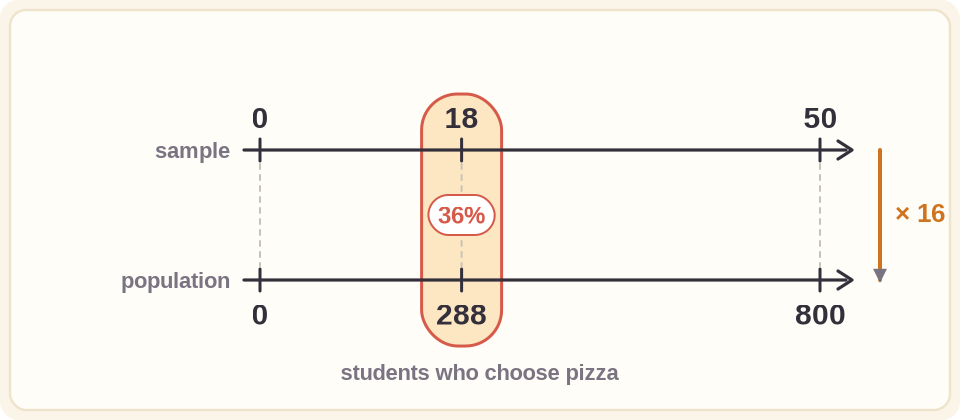
The cafeteria asks a random sample of 50 of the school's 800 students what lunch they like best, and 18 choose pizza. About how many of all 800 students would choose pizza?
From the sample to the population
A random sample tends to look like the population, so we expect about the same fraction of the population to choose pizza.
In the sample, 18 out of 50 chose pizza: = 36%.
36% of 800 is 0.36 × 800 = 288. So about 288 students in the school would choose pizza.
The same thing as a proportion: = . The scale factor from 50 to 800 is 16, and 18 × 16 = 288.
Estimating a mean
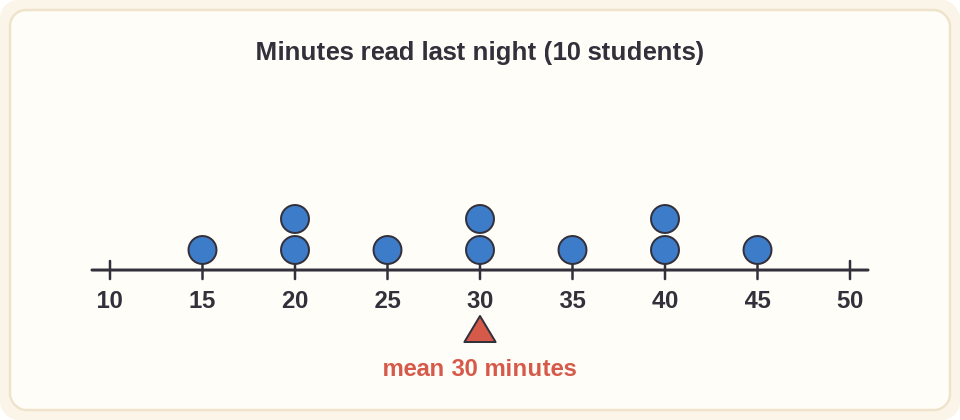
A random sample of 10 students wrote down how many minutes they read last night: 20, 35, 15, 40, 30, 25, 30, 45, 20 and 40.
Their total is 300 minutes, so their mean is 300 ÷ 10 = 30 minutes. Our best guess for the whole school is that a typical student reads about 30 minutes a night.
An estimate, not the answer
A conclusion about a population drawn from a sample is an inference. Its numbers are estimates: say about 288 students, not exactly 288.
An inference is only as good as its sample. From the gaming club you cannot infer anything about the whole school, however carefully you work it out.
Try it at home
- Open a book at a random page and count how many of the first 50 words are the word the.
- Find the percent.
- Use it to estimate how many times the appears in 1,000 words of the book.
Words in this lesson
- inference - a conclusion about a population drawn from a sample.
- estimate - a number that is close to the true one but not exact.
Big idea
Use the percent or the mean of a random sample as an estimate for the whole population, and say about.