Multiplying and Dividing Negative Fractions
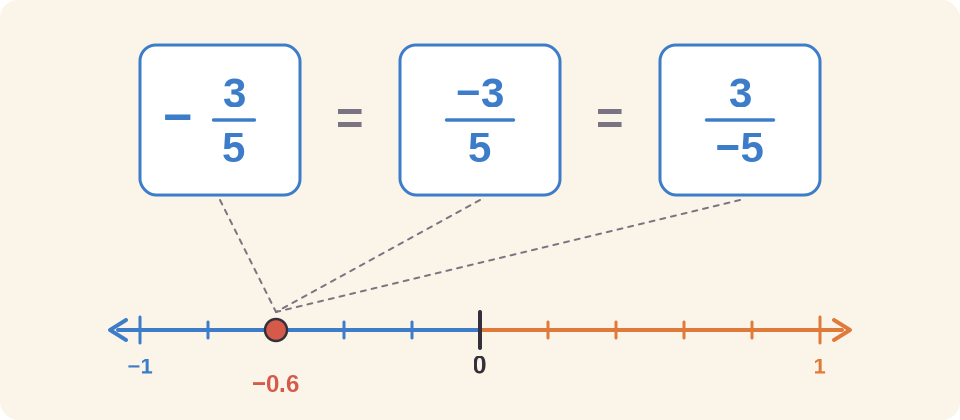
Where does the minus sign go in a negative fraction: in front, on the top, or on the bottom? All three places give the same number.
Three ways to write it
−3 ÷ 5 = −0.6, and 3 ÷ (−5) = −0.6 too, because different signs give a negative quotient. And the opposite of is −0.6.
So . In general, , as long as q is not 0.
But is positive: two negatives in a division give a positive, so it equals .
Sign first, then size
To multiply or divide negative fractions, decide the sign by counting the negatives, then work out the size as usual.
(−) × : one negative, so negative; × = = . The answer is −.
(−) ÷ (−): two negatives, so positive; × 2 = . The answer is .
Decimals
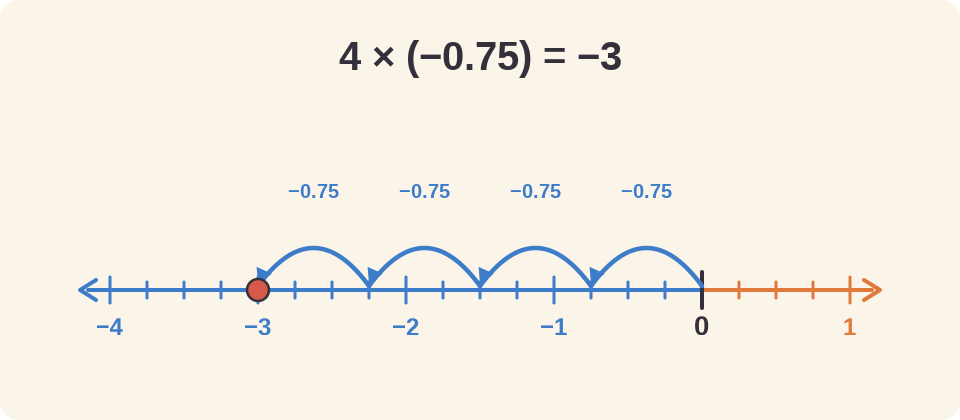
Decimals follow the same rules: 4 × (−0.75) = −3, (−0.5) × (−0.4) = 0.2, and (−4.8) ÷ (−0.6) = 8.
Try it at home
- Write −2/5 in all three ways on three cards.
- Divide on a calculator to check each one gives −0.4.
- Then try (−2)/(−5) and see what you get.
Words in this lesson
- negative fraction - a fraction less than 0, written −3/5, (−3)/5 or 3/(−5).
- reciprocal - the number you multiply by to get 1: the reciprocal of −2/3 is −3/2.
Big idea
The minus sign of a fraction can go in front, on top or on the bottom; to multiply or divide, find the sign by counting negatives, then the size.