Expanding and Factoring
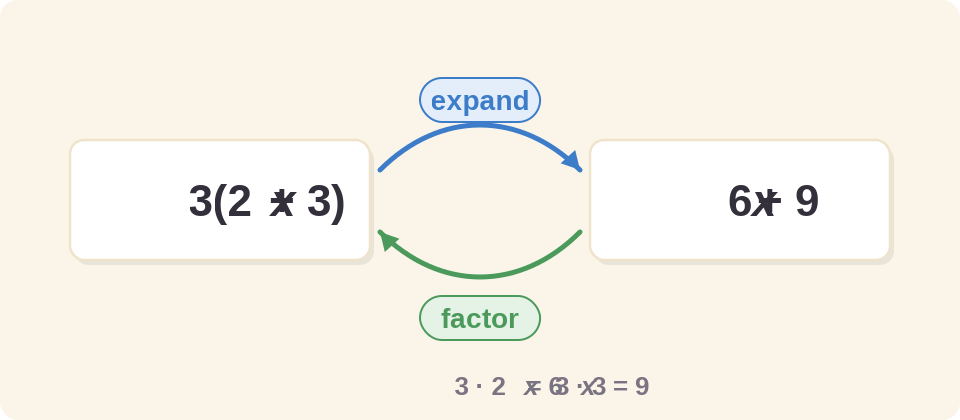
and are the same expression in two shapes. One is a product, the other a sum. Going from one shape to the other is a skill you will use in every equation.
Expanding
To expand , multiply the number outside by each term inside: . This is the distributive property.
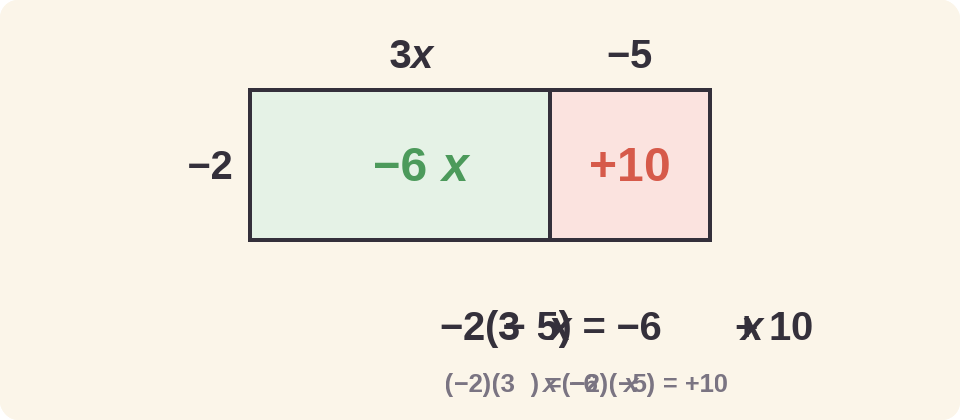
With negatives, keep the signs with the terms: is −2 times plus −2 times −5, which is . A rectangle split in two parts shows each product.
Factoring
To factor a sum, find a factor every term shares and take it out in front. In , both 6 and 9 are multiples of 3, so .
Take out the greatest common factor, so nothing more can come out. . is equal too, but 3 could still come out of the bracket.
With a negative first term you may take out a negative factor: . Check by expanding: −4 times x is , and −4 times 2 is −8.
Careful
When you expand , the −2 multiplies the −5 too. forgets that a negative times a negative is positive.
Try it at home
- Write 3(2x + 3) and 6x + 9 on two cards.
- Put x = 0, 1, 2 and −1 into both and compare the answers.
- Make two more pairs of cards with a negative number outside the bracket, and test them the same way.
Words in this lesson
- expand - to multiply out a bracket: −2(3x − 5) becomes −6x + 10.
- factor - to write a sum as a product by taking out a common factor: 6x + 9 becomes 3(2x + 3).
Big idea
Expanding multiplies the outside number by every term in the bracket, and factoring takes a shared factor out again; both give the same expression in another shape.