Adding Negative Fractions and Decimals
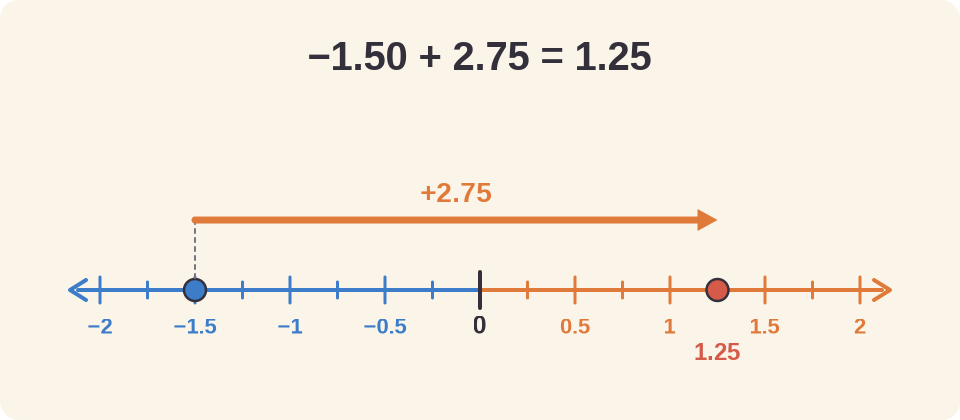
A bank account is overdrawn by $1.50, a balance of −1.50 dollars. Then $2.75 is paid in. What is the balance now? The rules for integers work for decimals and fractions too.
Decimals
−1.50 + 2.75: the signs are different, so subtract the sizes, 2.75 − 1.50 = 1.25, and keep the sign of the bigger size, which is positive. The balance is $1.25.
Same signs: −0.8 + (−1.6) = −2.4. Add the sizes, keep the minus.
Fractions
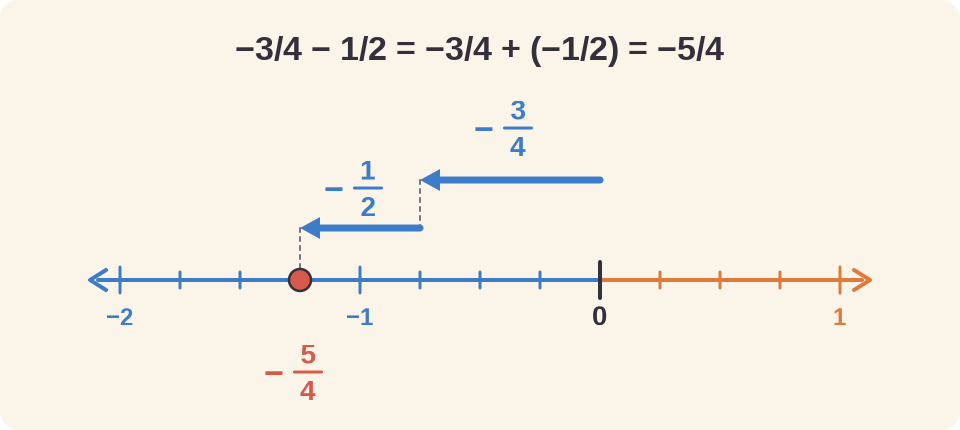
For − − , rewrite the subtraction as adding the opposite: − + (−).
Both are negative, so add the sizes with a common denominator: + = . The answer is −, or −.
Subtracting a negative fraction
− (−) = + = + = .
Mixed numbers work the same way: − + : different signs, so − = , and the answer is −.
Try it at home
- Find an old receipt or bank statement (or make one up) with money in and money out.
- Write money in as positive and money out as negative decimals.
- Add them all in one sum, grouping the positives and the negatives, to find the final balance.
Words in this lesson
- rational number - a number that can be written as a fraction of integers, like −3/4, 2.75 or −6.
- balance - how much money is in an account; negative when more has been taken out than put in.
Big idea
Negative fractions and decimals follow the same rules as integers: rewrite a subtraction as adding the opposite, then add.