Volume and Surface Area Problems
Painting a box and filling it with sand are different jobs. Paint covers a surface area; sand fills a volume. Which one does a problem want?
Cover or fill?
Paint, wrapping paper, glass, cloth and labels cover, so find an area in square units. Water, sand, air and concrete fill, so find a volume in cubic units.
A toy chest 60 cm long, 40 cm wide and 30 cm high holds 60 × 40 × 30 = 72,000 cm³. Painting its whole outside covers 2 × (2,400 + 1,800 + 1,200) = 10,800 cm².
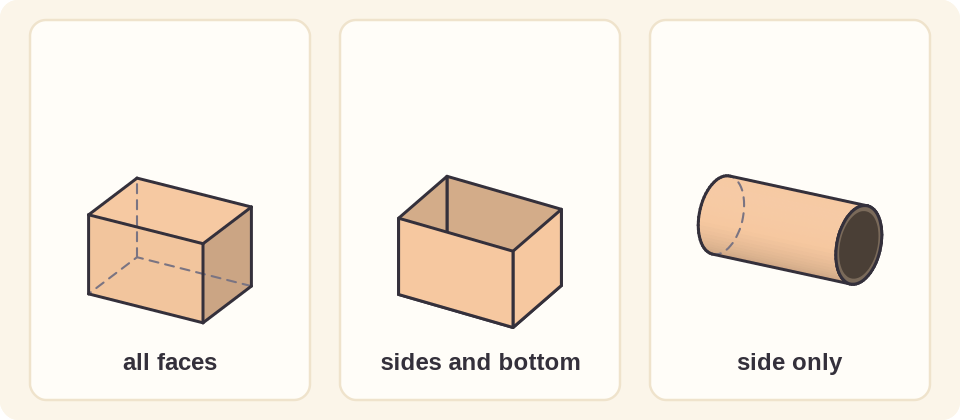
Which faces count?
A fish tank has no lid, so leave out the top. A pipe is open at both ends, so it is only its lateral area. The walls of a room are its lateral area, with no floor or ceiling.
A tank with no lid, 60 cm long, 30 cm wide and 40 cm high: the sides are (60 + 30 + 60 + 30) × 40 = 7,200 cm², and the bottom is 60 × 30 = 1,800 cm². It takes 9,000 cm² of glass.
One sheet, two tubes
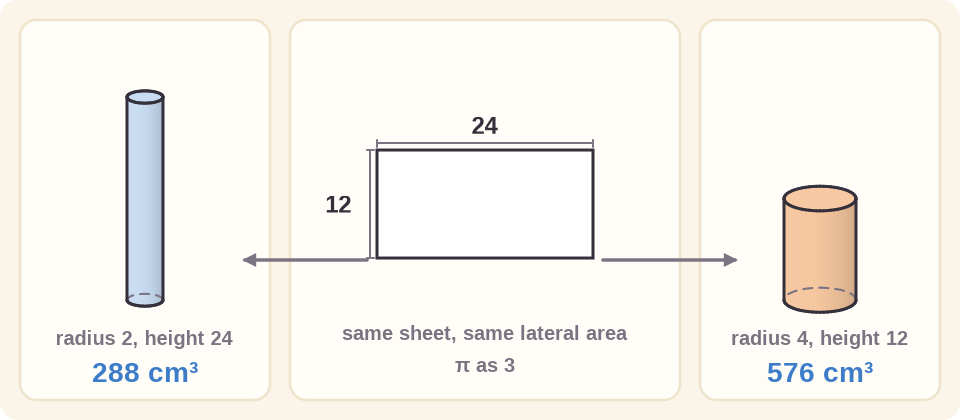
Roll a sheet of paper 24 cm by 12 cm into a tube the tall way and the short way. Both tubes use the whole sheet, so they have the same lateral area.
But they don't hold the same. With π as 3, the tall thin tube has a radius of 2 cm and a height of 24 cm: 3 × 2 × 2 × 24 = 288 cm³. The short wide tube has a radius of 4 cm and a height of 12 cm: 3 × 4 × 4 × 12 = 576 cm³.
The radius counts twice in the volume and the height only once, so the short wide tube holds twice as much.
Try it at home
- Roll two equal sheets into tubes, one each way.
- Fill the tall one with rice, then pour it into the wide one. Which holds more?
Words in this lesson
- surface area - how much covers the outside of a solid, in square units.
- volume - how much fills the inside of a solid, in cubic units.
- open box - a box with no lid, so its top is not part of its surface area.
Big idea
Ask whether a problem covers (surface area, square units) or fills (volume, cubic units), and count only the faces that are really there.