Moving Shapes on the Plane
Trace a shape on tracing paper. Slide the paper, flip it over or spin it around a pin, and the shape lands somewhere new, still the same shape. These are the three moves of geometry.
Translations
A translation slides every point the same distance in the same direction, like 6 right and 2 up. The image of a point A is written A′, "A prime".
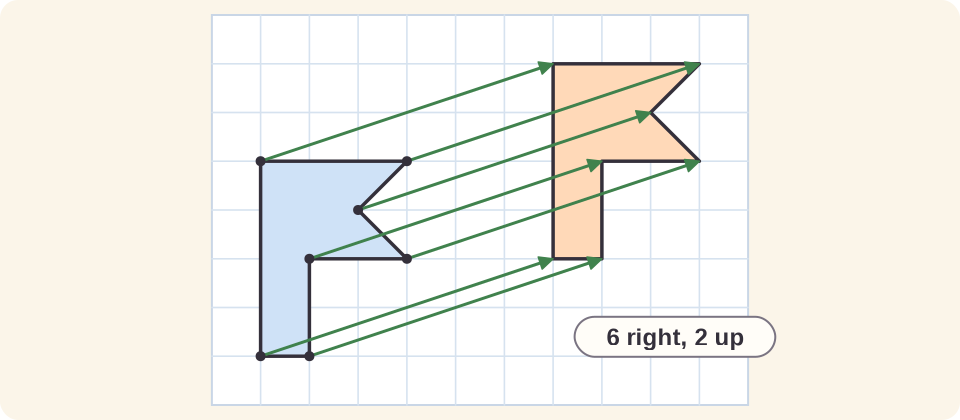
On the coordinate plane, 6 right and 2 up takes (x, y) to (x + 6, y + 2), so (−3, 1) goes to (3, 3).
Reflections
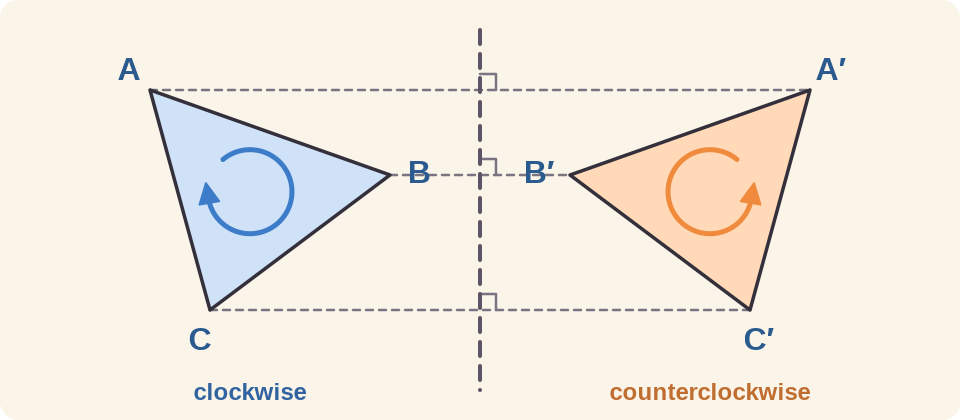
A reflection flips a shape over a line, the line of reflection. Each point and its image are on opposite sides, just as far from the line, joined by a segment that crosses it at a right angle.
So to find the line, mark the middles of two point-and-image pairs and join them.
A reflection changes the orientation: if A, B, C go around clockwise, A′, B′, C′ go counterclockwise.
Rotations
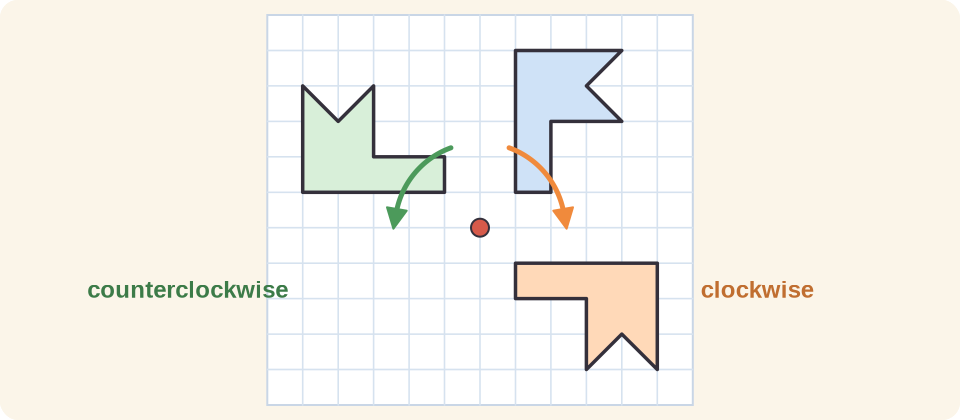
A rotation turns a shape by an angle about a fixed point, the center of rotation.
A 90° turn needs a direction: clockwise and counterclockwise end in different places. A 180° turn doesn't: half a turn either way ends in the same place.
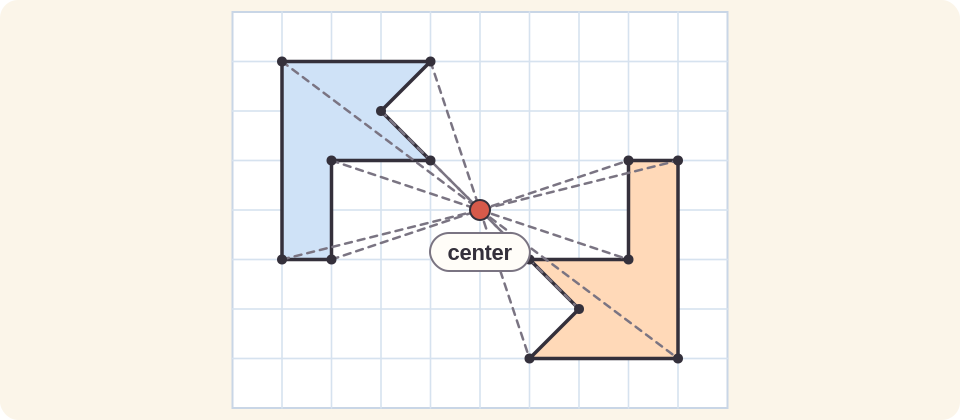
In a half-turn, a point and its image are on opposite sides of the center, just as far away, so the center is the middle of the segment joining them. A half-turn about the origin takes (4, 1) to (−4, −1).
What the moves keep
All three moves keep lengths and angles: the image has the same shape and size. Only a reflection flips the orientation.
Try it at home
- Trace the letter F on tracing paper.
- Slide it, flip it, and turn it around a pencil point.
- Which copy can't be matched to the first by sliding and turning alone?
Words in this lesson
- translation - a slide: every point moves the same distance in the same direction.
- reflection - a flip over a line, the line of reflection; it makes a mirror image.
- rotation - a turn about a fixed point, the center of rotation, by an angle.
- orientation - which way around a shape's corners go, clockwise or counterclockwise.
Big idea
All three moves keep lengths and angles, only a reflection flips the orientation, and the middle of a point and its image finds a mirror line or a half-turn's center.