Random Samples
Jo wants to know how many hours a week the students at her school play video games. She asks the members of the gaming club. What could go wrong?
Samples that lean one way
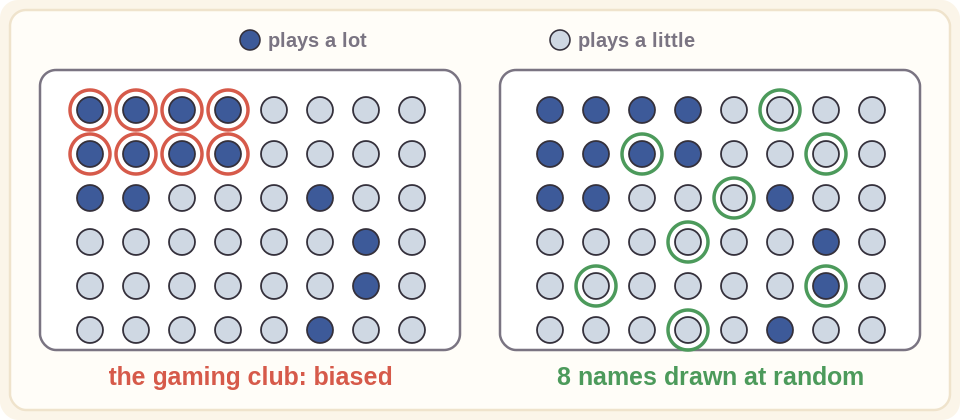
The gaming club plays more video games than most students, so Jo's answers will be too high. A sample that leans one way, so that it does not look like the population, is biased.
Some other biased samples: asking your friends, who are a lot like you; asking people at a library how much they read; an online poll, where only people who care a lot choose to answer.
Even a big sample can be biased. Asking 200 people at a football game whether they like football will not tell you what the whole town thinks.
Giving everyone the same chance
In a random sample, every member of the population has the same chance of being picked.
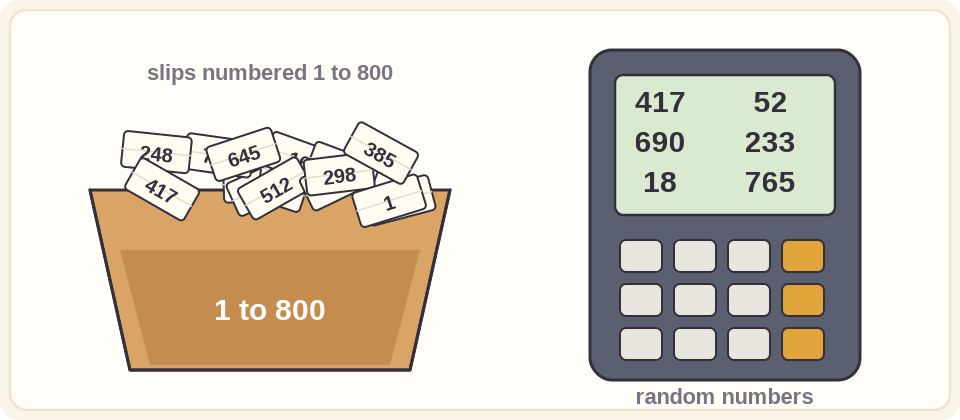
Jo could write every student's name on a slip, mix the slips in a box and draw 50 without looking. Or she could number the students from 1 to 800 and let a computer pick 50 random numbers.
Nobody chooses who gets in, not Jo and not the students themselves, so nothing pushes the sample one way.
Fair, not perfect
A random sample tends to look like the population. It can still be unlucky: 50 slips drawn from a box could, by chance, be mostly gamers. But with a fair draw that is rare, and it gets rarer as the sample gets bigger.
Careful
A bigger sample does not fix a biased way of choosing it. Choose at random first.
Try it at home
- Write the numbers 1 to 30 on slips, one for each student in a class, and mix them in a cup.
- Draw 5 slips without looking. Write down the numbers and put them back.
- Do it three more times. Did the same students always get picked?
Words in this lesson
- biased - leaning one way, so a sample does not look like its population.
- random sample - a sample where every member of the population has the same chance of being picked.
Big idea
A random sample gives everyone the same chance, so it tends to look like the population; a biased one leans one way.