Arithmetic or Algebra?
Maya thinks of a number, doubles it and takes away 1. She gets 9. You can find her number by working backwards, or by solving . What is the difference, and when does only one of them work?
Two ways, the same steps
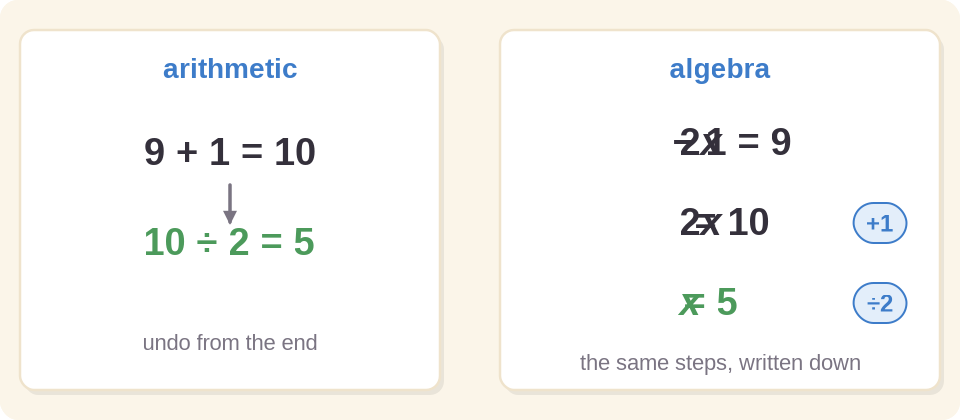
Working backwards in arithmetic: she ended at 9 after taking away 1, so before that she had 10. Before doubling she had 5.
In algebra: , add 1 to both sides, , divide by 2, . The operations are the same, in the same order. Algebra just writes down every step.
When working backwards breaks
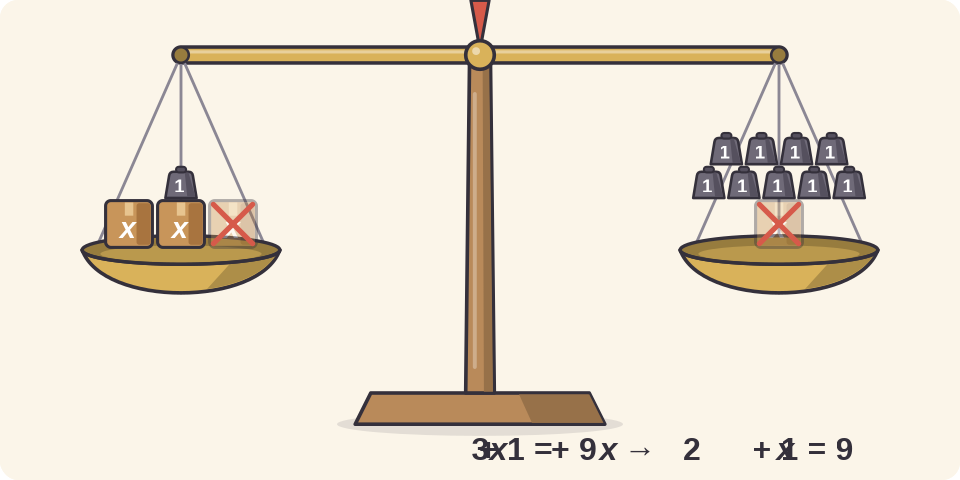
Now take . The unknown is on both sides, so there is no single end point to work back from. Algebra still works: take one x from both sides of the balance.
That leaves , which is a two-step equation: , . Check: 3 × 4 + 1 = 13 and 4 + 9 = 13.
Negative and fraction answers
Take the same amount of x from both sides, usually the smaller one. : take from both sides, , so and .
An answer need not be a whole number. : take , , add 3, , so . Check: and .
Try it at home
- Ask a friend to think of a number, multiply by 3 and add 4, and tell you the result. Find the number by working backwards.
- Now ask: multiply your number by 3 and add 4; multiply it by 2 and add 9. If both give the same result, what was the number?
- Write that one as an equation and solve it.
Words in this lesson
- working backwards - undoing the steps of a problem from its end, in reverse order.
- unknown on both sides - an equation like 3x + 1 = x + 9, solved by taking the same amount of x from both sides first.
Big idea
Working backwards and algebra use the same steps, but only algebra can solve an equation with the unknown on both sides.