Rules for Adding Integers
Counters and number lines show why a sum comes out as it does. But for (−38) + (+25) you don't want to put out 63 counters. Two short rules do the same work.
Same signs
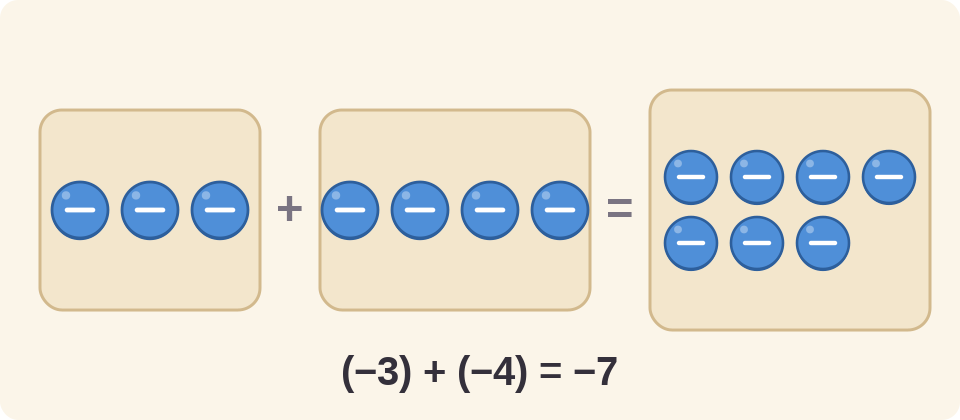
When both numbers have the same sign, the moves go the same way. Add their sizes and keep the sign.
(−3) + (−4): the sizes are 3 and 4, so the answer has size 7, and it is negative: −7. Likewise (+12) + (+9) = +21.
Different signs
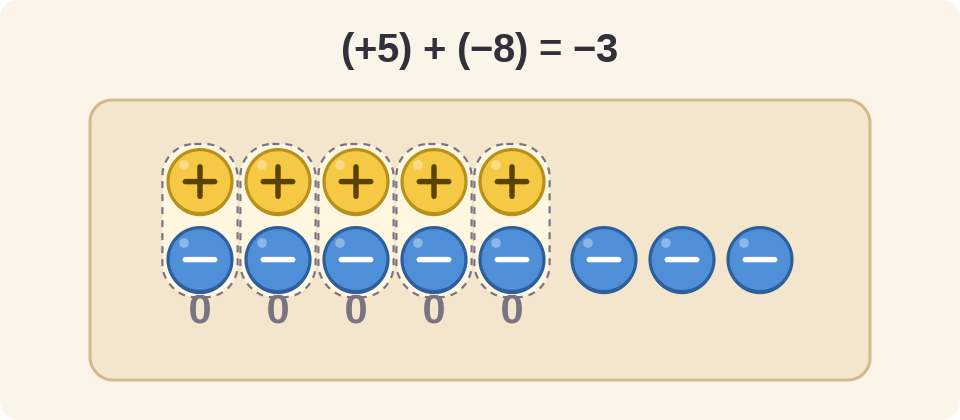
When the signs are different, the moves undo each other. Subtract the smaller size from the bigger, and give the answer the sign of the number with the bigger size.
(+5) + (−8): 8 − 5 = 3, and 8 belongs to the negative number, so the answer is −3. With counters, 5 zero pairs cancel and 3 blue counters are left.
(−38) + (+25): 38 − 25 = 13, and 38 is negative, so the sum is −13.
Size is absolute value
The size of a number is its absolute value, its distance from 0: . So the rule for different signs says: subtract the absolute values and keep the sign of the one with the bigger absolute value.
If the sizes are equal, like (−9) + (+9), the answer is 0: the two numbers are opposites.
Careful
(−8) + (+3) is not +5 or −11. The signs are different, so subtract: 8 − 3 = 5, and the bigger size is negative: −5.
Try it at home
- Write five sums of two integers between −20 and 20 on cards.
- Sort the cards into same signs and different signs.
- Work each one out with the rule, then check one of them with counters.
Words in this lesson
- absolute value - the distance of a number from 0, never negative: |−8| = 8.
- integer - a whole number or its opposite: ..., −2, −1, 0, 1, 2, ...
Big idea
Same signs: add the sizes and keep the sign. Different signs: subtract the sizes and keep the sign of the bigger size.