Like Terms with Negatives
You already know . But what is ? Once terms can be negative, combining them is adding signed numbers, and the letter just comes along.
Combine the coefficients
Like terms have the same letter part, like and . To combine them, add their coefficients, the numbers in front, as signed numbers: 5 + (−8) = −3.
So . The 2 has no letter, so it is not like the others and stays as it is.
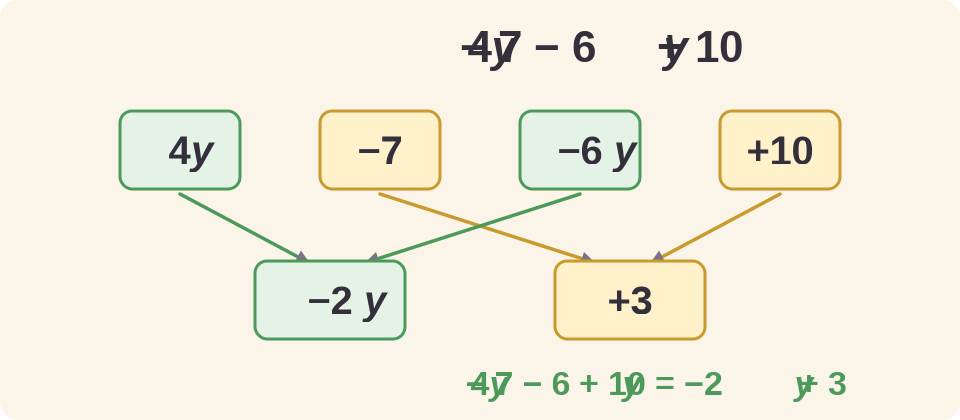
Read each term together with the sign in front of it. In the terms are , , and . The y-terms make and the numbers make 3: .
Fractions and decimals
Coefficients can be fractions or decimals too. , and .
A letter on its own has coefficient 1, and has coefficient −1. So .
Taking away a whole expression
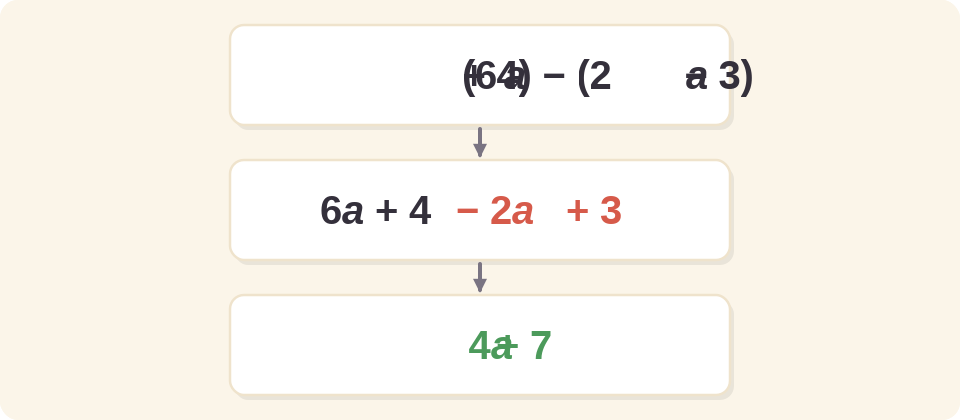
In , the whole second bracket is taken away. Taking it away takes away each of its terms: , and taking away is adding 3.
So the expression becomes , which is . A minus sign in front of a bracket changes the sign of every term inside it: .
Try it at home
- Write five terms on slips of paper, some with a letter and some without, some negative.
- Ask a friend to make an expression from them.
- Combine the like terms, then check by putting x = 2 into both the long and the short expression.
Words in this lesson
- like terms - terms with the same letter part, such as 5a and −8a; numbers on their own are like terms too.
- coefficient - the number in front of a letter: in −3a the coefficient is −3.
Big idea
Combine like terms by adding their coefficients as signed numbers, and a minus sign before a bracket changes the sign of every term inside it.