Volume of Prisms
A box, a tent-shaped chocolate bar and a six-sided pencil are all prisms. One rule finds all their volumes.
Layers on a base
A prism is a solid with two equal, parallel faces, its bases, joined by rectangles.
Fill a prism with 1 cm cubes. The bottom layer has as many cubes as the base has square centimeters. Every layer above it is the same. So the volume is the base's area times the height: .
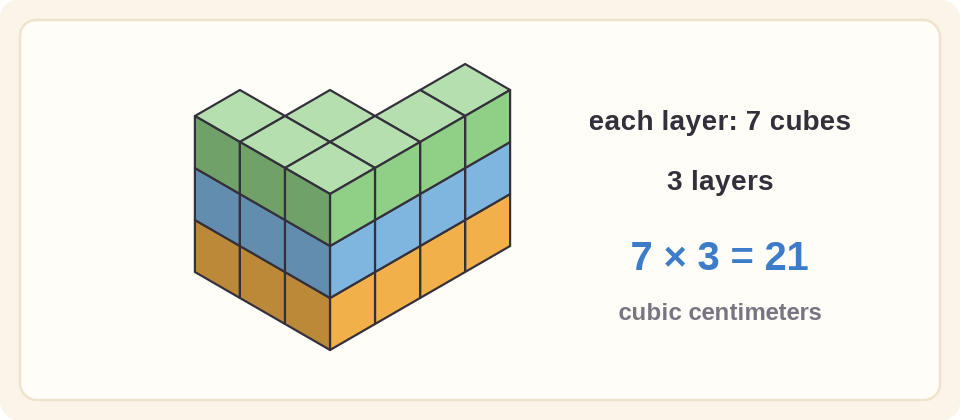
Only the base's area matters: a base of 12 cm² and a height of 5 cm give 60 cm³, whatever its shape.
A prism lying down
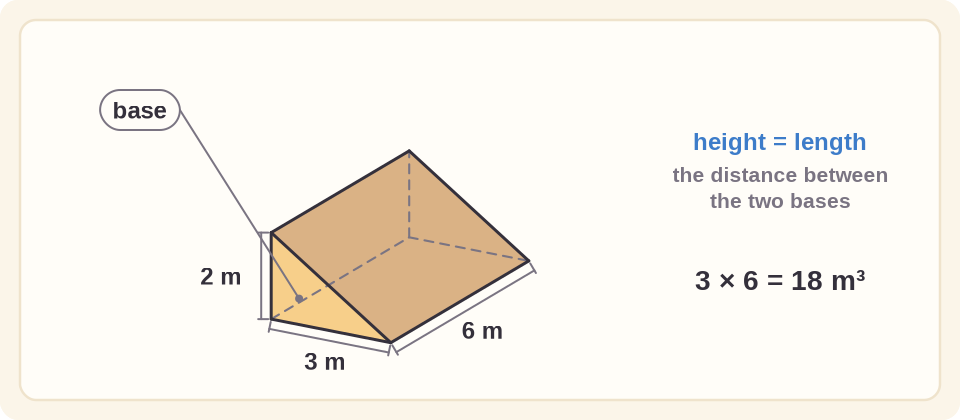
The height of a prism is the distance between its two bases. When a prism lies on its side, its height is its length.
A wooden wedge is a prism lying down. Its end is a right triangle 3 m long and 2 m high, and it is 6 m long. Base: 3 × 2 ÷ 2 = 3 m². Volume: 3 × 6 = 18 m³.
Cylinders work the same way
A cylinder is like a prism with a circle for its base. Its volume is the circle's area times the height: .
A can with a radius of 2 cm and a height of 10 cm: with π as 3.14, the base is 3.14 × 2 × 2 = 12.56 cm², and the volume is 125.6 cm³. With π as 3 for a quick estimate, it is about 3 × 2 × 2 × 10 = 120 cm³.
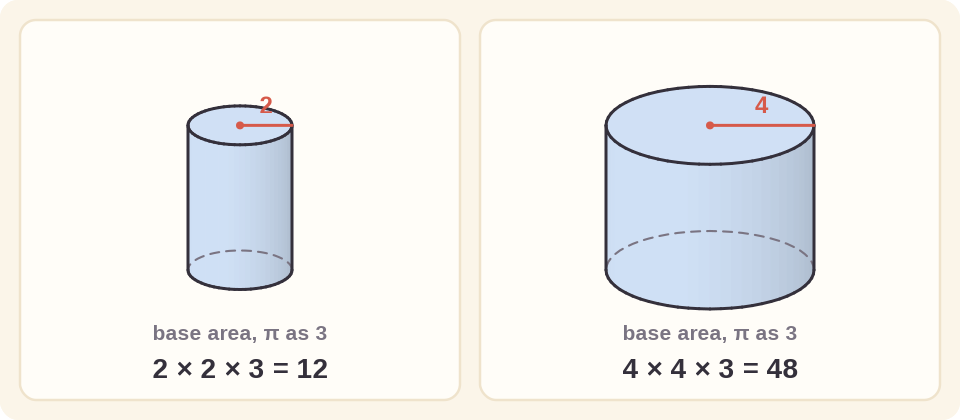
Double the radius, and the base is 2 × 2 = 4 times as big, since the radius is multiplied in twice. So is the volume.
A cubic meter holds 1,000 liters, so a 2 m³ tank holds 2,000 liters.
Try it at home
- Measure the radius and height of a can of food.
- Work out its volume with π as 3.14.
- Compare it with the milliliters on the label: 1 mL is 1 cm³.
Words in this lesson
- prism - a solid with two equal, parallel bases joined by rectangles.
- height of a prism - the distance between its two bases.
- cylinder - a solid with two equal circles for bases and a curved side.
Big idea
The volume of any prism or cylinder is the area of its base times its height, the distance between the two bases.