Is It Proportional?
Movie tickets cost the same each, so 4 tickets cost twice as much as 2. A taxi ride of 4 miles does not cost twice as much as 2 miles. Why not, and how can you tell?
Look at y ÷ x in a table
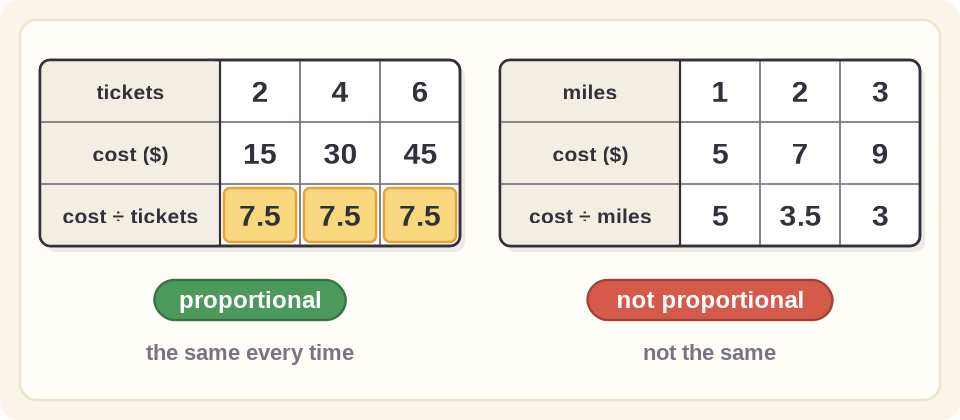
Two quantities are proportional when one is always the same number times the other. In a table, divide each y by its x.
Tickets: 2 cost $15, 4 cost $30, 6 cost $45. Each time 15 ÷ 2 = 30 ÷ 4 = 45 ÷ 6 = 7.5. The same every time, so the cost is proportional to the number of tickets.
Taxi: 1 mile costs $5, 2 miles $7, 3 miles $9. Now 5 ÷ 1 = 5, but 7 ÷ 2 = 3.5. Not the same, so it is not proportional. The taxi starts with a $3 fee before it moves at all.
Look at the graph
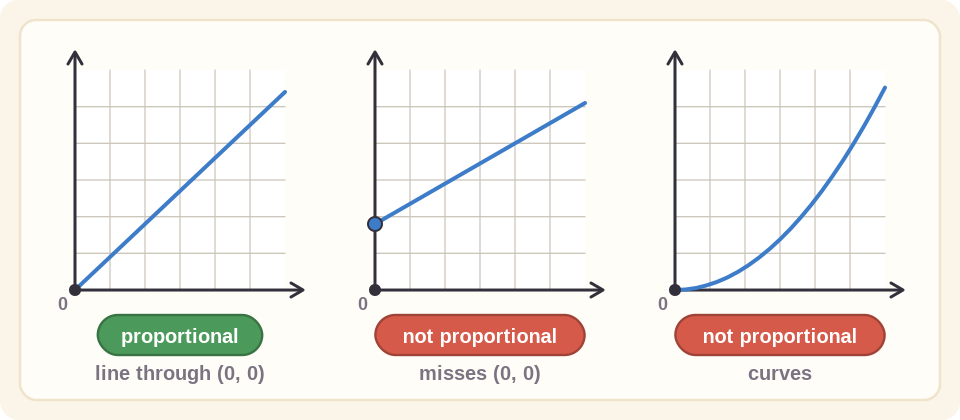
Plot the pairs (x, y). The points of a proportional relationship always lie on a straight line through the origin, the point (0, 0): no tickets cost nothing.
The taxi's points lie on a straight line too, but it crosses the y-axis at 3, not 0. A line that misses (0, 0) is not proportional.
Points that curve, like the side and the area of a square, are not proportional either.
Careful
A straight line is not enough. It must also pass through (0, 0).
Try it at home
- Count the legs on 1, 2, 3 and 4 chairs and make a table.
- Divide legs by chairs for each column. Is it the same every time?
- Now make a table of your age and your height over the years. Is height proportional to age?
Words in this lesson
- proportional - two quantities are proportional when y ÷ x is the same for every pair.
- origin - the point (0, 0), where the axes cross.
Big idea
A table is proportional when y ÷ x never changes; a graph is proportional when it is a straight line through (0, 0).