Proportional Stories
Gym A charges $8 a visit. Gym B charges a $20 joining fee and then $4 a visit. Which cost is proportional to the visits, and which gym is cheaper?
Is the story proportional?
Ask: does 0 of one thing mean 0 of the other, and does doubling one double the other?
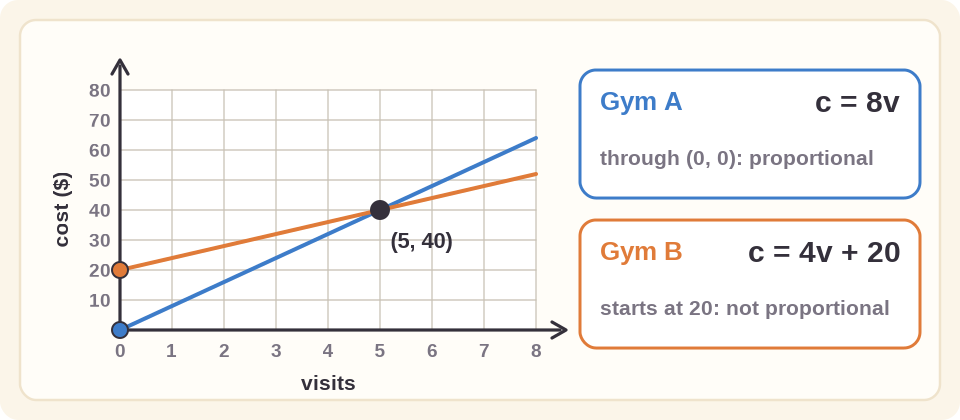
Gym A: 0 visits cost $0, and 10 visits cost twice as much as 5. Its cost is proportional: .
Gym B: 0 visits already cost $20. Its cost is not proportional: , and its line does not pass through (0, 0).
Use the equation
For 3 visits, A costs and B costs . For 8 visits, A costs 64 and B costs 52.
At 5 visits they both cost $40. Fewer visits, A is cheaper; more visits, B is cheaper.
Not every story is proportional
Some stories sound proportional but are not. Your age and your height grow together, but a 12-year-old is not twice as tall as a 6-year-old.
A phone plan with a $10 monthly fee plus $0.05 a text is not proportional. Mangoes at $1.25 each are.
Try it at home
- Find two prices for the same thing, one with a fee and one without (a bike rental, a delivery).
- Write an equation for each.
- For how many uses is the first cheaper?
Words in this lesson
- proportional story - a story where 0 of one amount gives 0 of the other and doubling one doubles the other.
- fixed fee - an amount paid once, whatever the amount used; it stops a cost from being proportional.
Big idea
Test a story for proportionality by asking if 0 gives 0 and doubling doubles; then write y = kx and use it.